

The Cobbler’s Shoes Problem
We built vLake to handle WordPress SEO autonomously. Scan the site, find what needs fixing, fix it — without someone spending their evenings in the editor catching up on a backlog that never gets shorter.
We told customers this was the answer to a problem we understood deeply. What we hadn’t done, embarrassingly, was run it seriously on our own site.
Our site had decent content. We’d published regularly. We told ourselves SEO was “pretty solid” the way you tell yourself your apartment is “pretty clean” when you haven’t really looked at it. So about six weeks ago, we connected vLake to our own WordPress installation, set a 30-day window, and decided to pay attention.
What we found surprised us in ways we honestly didn’t expect — and we’re the ones who built the thing.
1. The Biggest SEO Wins Were the Ones We’d Been Postponing
We expected vLake to surface something big. Some dramatic structural issue. A fundamentally broken page. Something that would feel like a revelation.
Instead, the highest-impact fixes were the boring ones. Old blog posts with weak focus keywords. Meta descriptions written in a rush two years ago, technically present but clearly not thought through. A few service pages we’d edited without ever reranking them. None of it was exciting. All of it was dragging the site down.
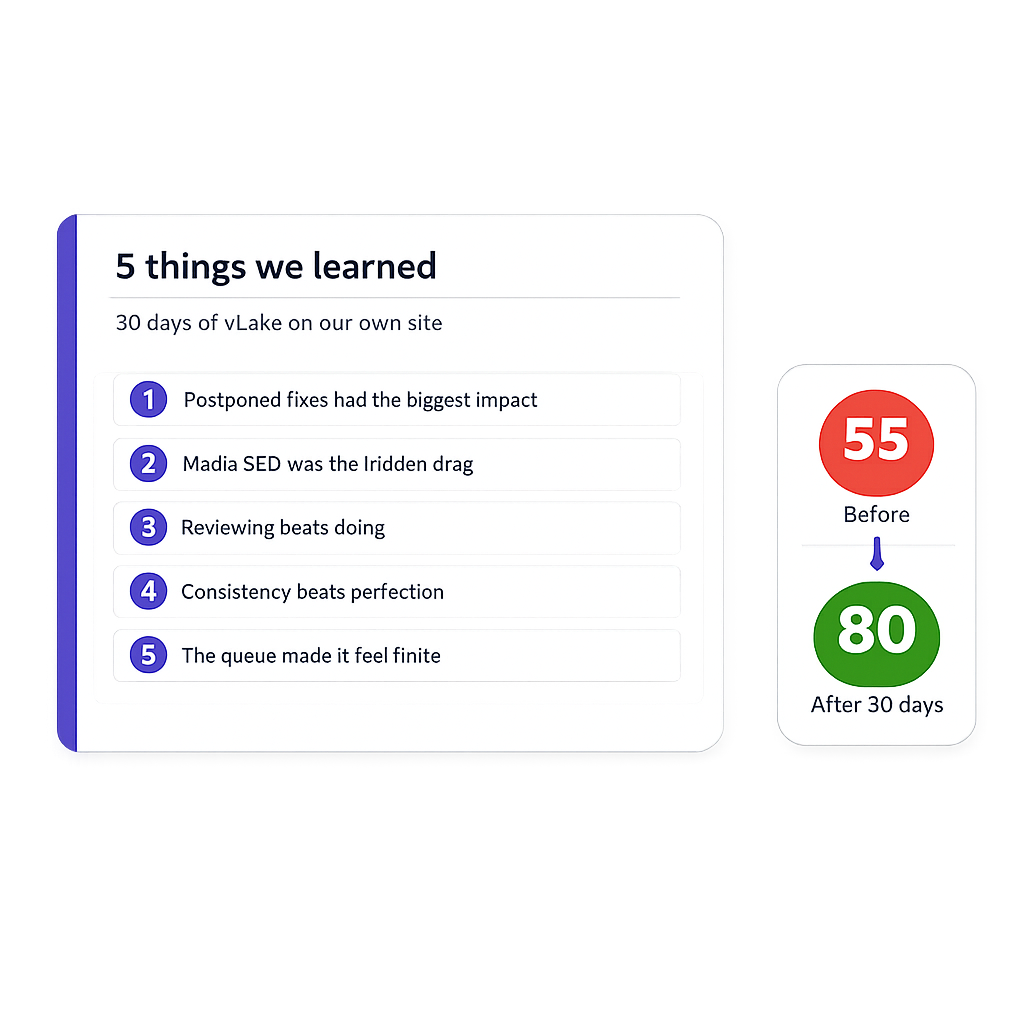
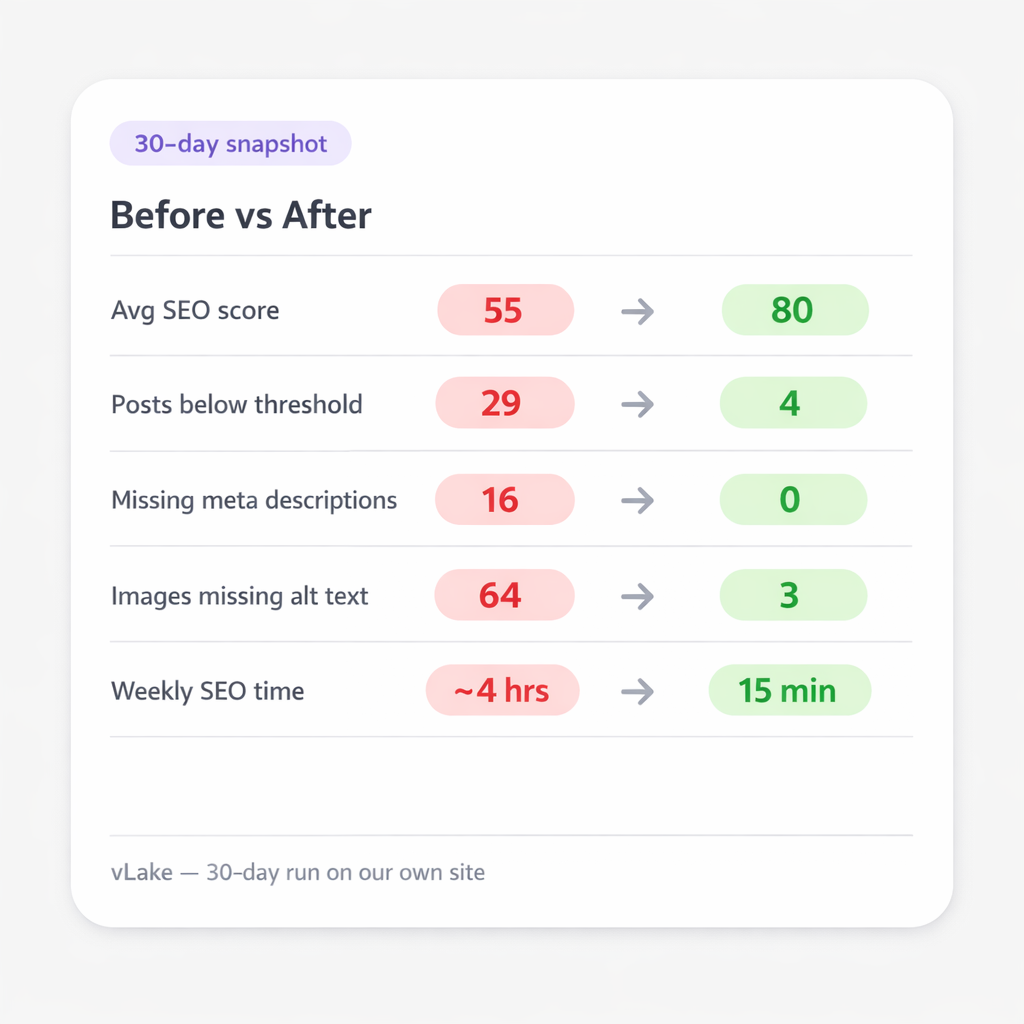
After vLake worked through the backlog — 16 posts with weak or missing meta descriptions, another dozen with stale focus keywords — our average SEO score moved from 55 to 80. Not because of some clever strategy. Because we finally did the maintenance work we’d been quietly postponing for months.
That’s the part that stuck with us. The wins weren’t the ones we’d been planning. They were the ones we kept not getting around to.
2. Our Media Library Was a Bigger SEO Problem Than Our Blog Posts
We expected the blogs to be the main issue. They weren’t.
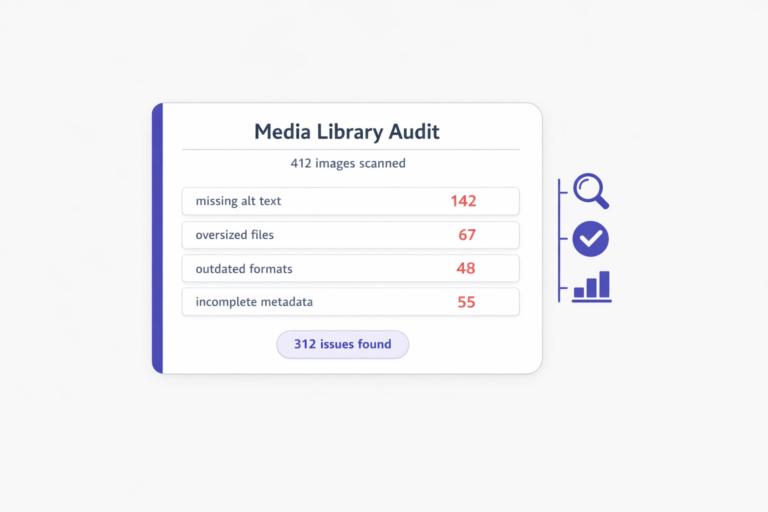
vLake scanned the whole site — posts, pages, and media — and the number that caught us off guard was 64. That’s how many images in our library had no alt text at all. Not incomplete alt text. None.
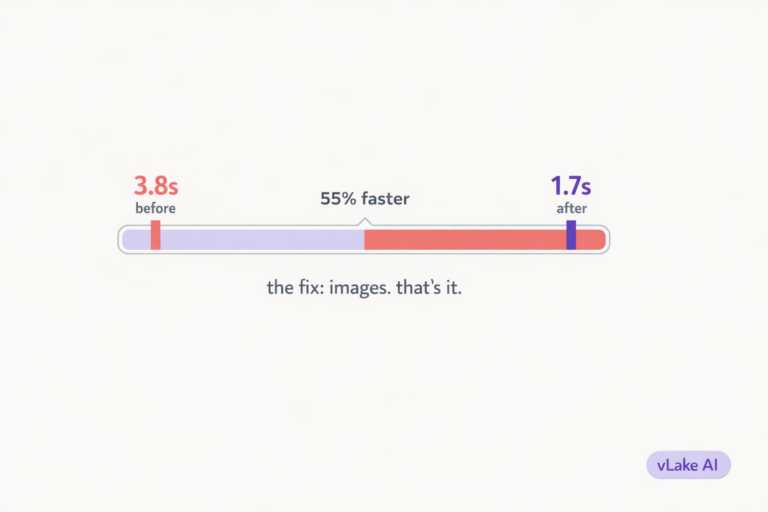
On top of that, 18 images were oversized. Not slightly oversized — some of them were several megabytes per image, sitting in the background quietly making our pages slower and our media SEO score worse every single day.
We’d been so focused on content-level SEO that we’d essentially ignored the media library as an SEO surface. vLake treated them as the same problem. The `MEDIA_MISSING_SEO` and `MEDIA_OPTIMIZE_SIZE` recommendations came up right alongside the blog post recommendations in the queue, ranked by impact, which forced us to look at them properly.
By the end of the first two weeks, alt text was generated for the flagged images and the oversized ones had been converted to WebP. The media library stopped being invisible debt.
3. Reviewing AI Work Is a Completely Different Skill
The first few days felt strange. We weren’t doing SEO work in the traditional sense — opening posts, rewriting metadata, saving, moving to the next one. We were reviewing what vLake had generated and deciding whether to let it push.
That mental shift took about a week to actually accept.
The old habit was: sit down, do the work, check it off. The new habit is: open the recommendation queue, review the batch, approve or adjust, close the tab. What used to take us close to four hours a week now takes about 15 minutes of actual attention.
The thing we had to get used to: trusting the output without micromanaging it. The first batch of AI-written meta descriptions, we reviewed every single one. Most were solid — better than the placeholder text they were replacing, and certainly more consistent than what we’d have written in ten-minute bursts across different days. A few needed a tweak. We adjusted those and moved on.
After about week two, we stopped second-guessing the queue. We’d calibrated what “good” looked like from vLake and could spot the rare exception quickly.
4. Sitewide Consistency Matters More Than Perfecting Individual Posts
Here’s something we intellectually knew but hadn’t fully felt until we ran the numbers.
We had a handful of blog posts with SEO scores in the 90s. Genuinely well-optimised pieces. We’d spent real time on those. Meanwhile, 29 other posts were below our threshold — scores in the 40s and 50s, dragging the site’s overall authority down.
Getting every post above 75 moved the needle more than getting our best posts to 95.
That’s not an obvious conclusion when you’re doing SEO manually, because your attention naturally gravitates toward the content you care most about. You polish the thing you’re proudest of. The archive sits.
vLake doesn’t have preferences. It works through the queue by impact. The posts that needed the most help got attention first, which is exactly the order we should have been working in all along but never were.
The `needsRerank` flag also helped here — any time we edited a post, it got re-scored automatically. No more editing content and forgetting to update the SEO. The system stayed current.
5. The Recommendation Queue Made SEO Feel Finite
Before vLake, our SEO situation felt like a fog. We knew things needed fixing. We didn’t know exactly what, or how much, or what to do first. That vague sense of “we should probably look at this” is genuinely demotivating. You can’t close a loop you can’t see.
The recommendation queue changed that completely.
Day one, we had a clear list: 29 blog posts below threshold, 16 missing meta descriptions, 64 media items with no alt text, 18 oversized images, 7 pages needing reranking. Each item had a status — `PENDING`, `QUEUED`, `REVIEW`, `COMPLETED`. We could see exactly what was being worked on and what had been resolved.
That visibility made the work feel manageable in a way it never had before. Not because there was less to do. There wasn’t. But because we could see the bottom of the pile.
Four weeks later, organic traffic was up about 14%. More importantly, the queue was mostly cleared. And for the first time, our site’s SEO health felt like something we were actually in control of — not something we were perpetually behind on.
—
We built vLake for WordPress site owners who are drowning in maintenance work they can’t keep up with. Turns out we were exactly that customer. It just took running it on our own site to see it.