

Why I Kept Blaming the Content
For a while, I thought my WordPress SEO problem was simple: the content was not good enough.
That is the advice you hear all the time. Write better posts. Add more depth. Improve the headline. Expand the sections. Update the copy. And sure, sometimes that is the right diagnosis. But I think it gets overused because it sounds smarter than saying, “your site has a backlog of boring maintenance work.”
I bought into that idea longer than I should have.
When a post underperformed, I rewrote the intro. If a page score looked weak, I added more copy. I spent one Saturday expanding three blog posts that were already pretty good, just because I assumed Google wanted “more content.” The scores barely moved.
That was the first clue. Not the traffic. The lack of movement after all that rewriting.
The content was not perfect, but it also was not the disaster I had convinced myself it was. The real problem was that I kept publishing and editing without doing the quiet SEO work that makes a site coherent over time. Meta descriptions were inconsistent. Old pages had changed without being reranked. Images were sitting there with no alt text because I uploaded them quickly and never circled back.
I think this is the WordPress SEO problem nobody talks about. The bottleneck is often not content quality. It is execution quality.
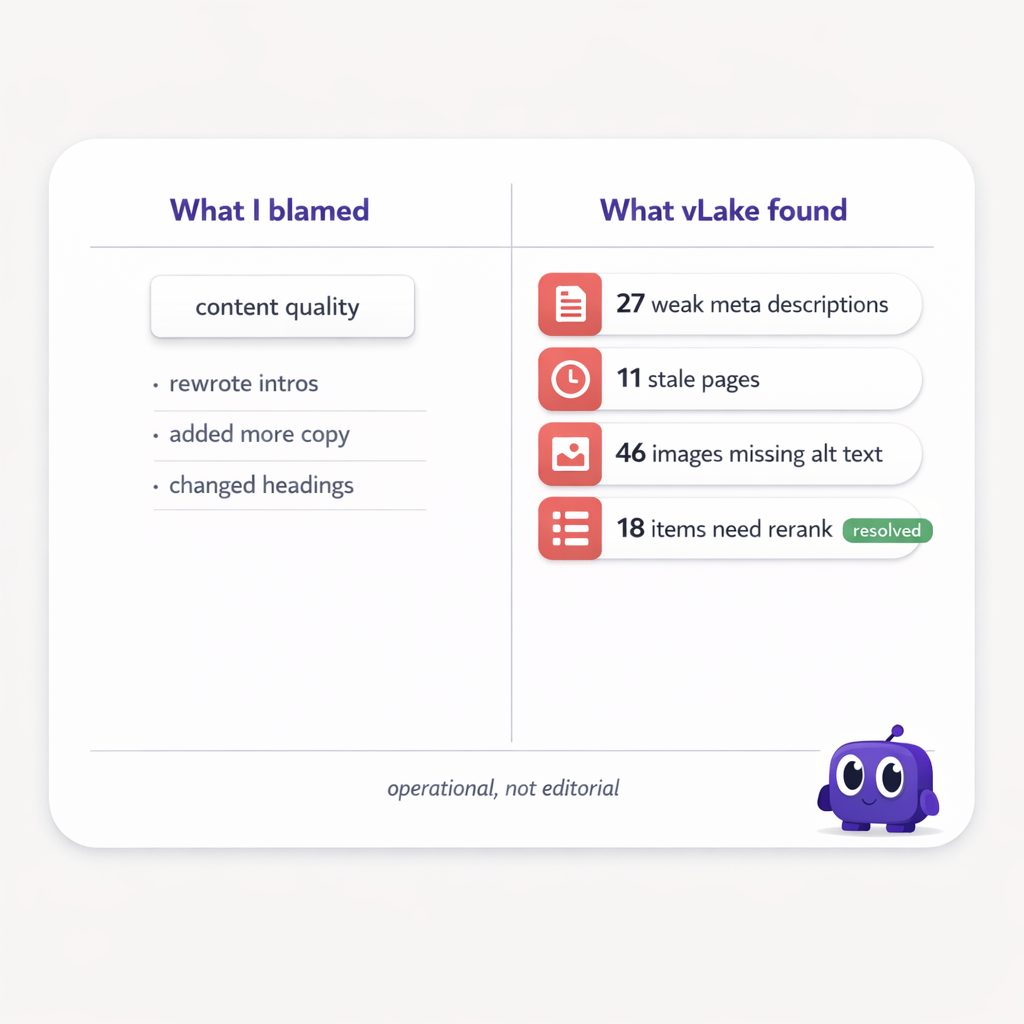
What vLake Found When I Finally Checked
I stopped guessing and ran vLake because I wanted something more honest than my own memory.
I connected the site, set the threshold, and let the recommendation engine scan the posts, pages, and media library. I expected it to confirm that I needed to rewrite half the site. That is not what happened.
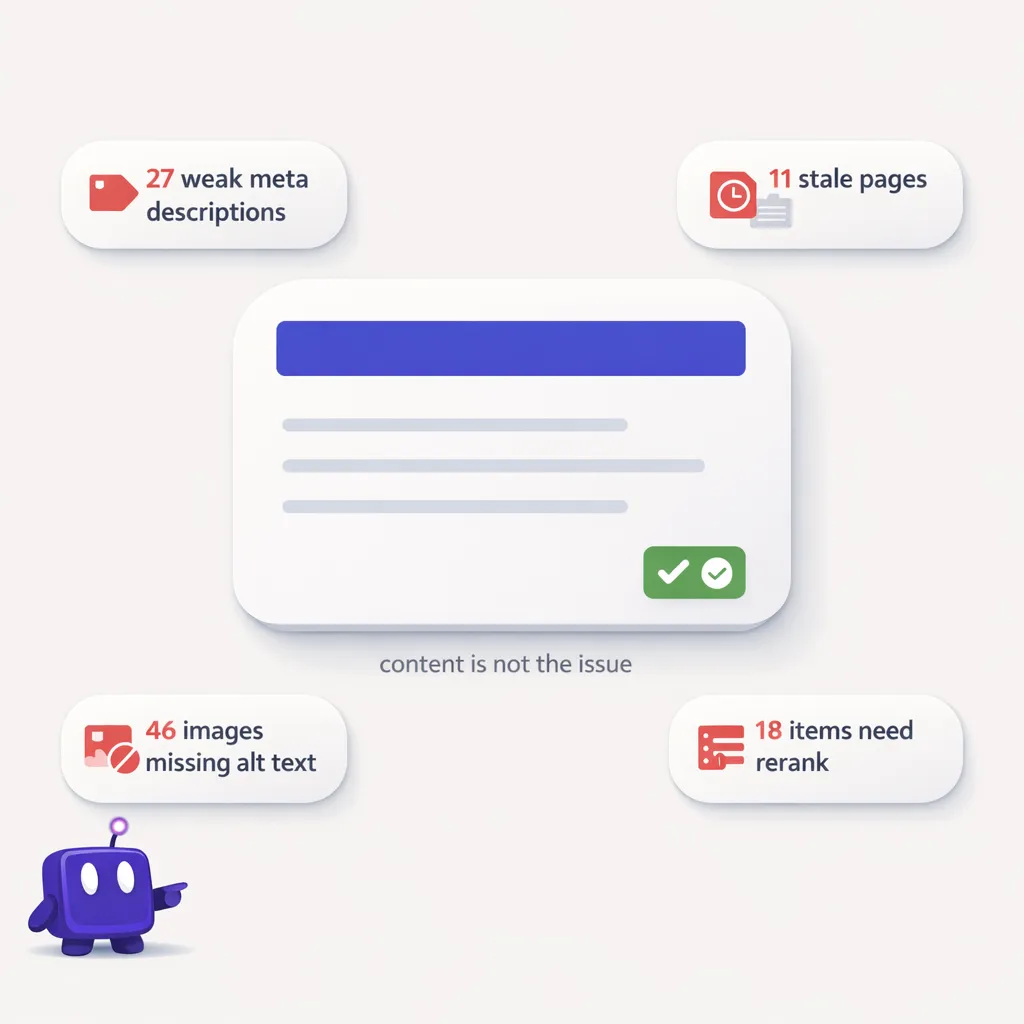
Here is what that first pass surfaced:
- `27` posts with weak or missing meta descriptions
- `11` pages with stale SEO after edits
- `46` images missing alt text
- `18` pieces of content marked for reranking
And the part that really got me: `7` of the posts I liked best were still scoring under `60`.
That mattered because those were not lazy posts. They had solid structure, useful information, and clear intent. What they did not have was clean SEO support around them. Some had thin or rushed metadata. Some had been edited without triggering the right follow-up work. A few were dragged down by surrounding issues that had nothing to do with the body copy.
Look, that was a little annoying to realize.
I had spent more time second-guessing my writing than checking whether the site was actually maintained properly.
The Real WordPress SEO Problem
The real WordPress SEO problem, at least on sites like mine, is that publishing is easy and maintenance is forgettable.
WordPress makes it very easy to hit publish and move on. That is great until you have thirty or forty posts, a handful of pages you revise every few months, and a media library full of quick uploads that never got proper cleanup. Then the site starts carrying invisible debt.
That debt shows up in unglamorous ways:
- metadata written too fast
- page SEO that goes stale after edits
- images missing alt text
- posts that need reranking but never get it
None of that is exciting. Nobody posts screenshots of a cleaned-up recommendation queue and says, “this changed my life.” But if you ignore it long enough, it quietly becomes the thing holding the site back.
My failed approach was trying to fix an operational problem with editorial effort. I kept treating weak scores like a writing assignment when a lot of them were really a maintenance assignment. That is why the earlier rewrites did not do much.
vLake made the difference because it did not just surface the issues. It grouped them into actual actions. Low-scoring content showed up in the queue. Rank Math-compatible fields like `focus_keyword`, `seo_title`, and `seo_desc` were generated where they were weak or missing. Edited content marked with `needsRerank` could be rescored after the SEO fixes landed. Media SEO gaps were visible in the same workflow instead of becoming another thing I would “totally get to later.”
That shift sounds small. It was not.
What Changed When I Fixed the Boring Stuff First
Once I stopped obsessing over rewriting content and started fixing the execution layer, the site got healthier fast.
I began with the `27` posts that had weak or missing metadata because that was the clearest example of content being blamed for a packaging problem. I reviewed the first batch of suggestions before letting vLake keep going, mostly because AI-written metadata can sound samey if you never sanity-check it. A few were too generic. I tightened what I approved and moved on.
After that, I let the queue lead. Pages with stale SEO got refreshed. The rerank backlog cleared. The media library started getting cleaned up in the background. What I liked most was that the work stopped feeling emotional. I was not sitting there wondering whether my writing was secretly terrible. I was just fixing the obvious sitewide gaps I had ignored.
After about three weeks, here is what changed:
Before
- Average SEO score on priority content: `59`
- Posts with weak or missing meta descriptions: `27`
- Pages below threshold: `11`
- Images missing alt text: `46`
- Items needing rerank: `18`
After
- Average SEO score on priority content: `81`
- Posts with weak or missing meta descriptions: `0`
- Pages below threshold: `3`
- Images missing alt text: `5`
- Items needing rerank: `0`
The surprise for me was not that the scores improved. It was which work moved them. The body copy rewrites I had spent time on before were not what drove the biggest lift. The boring stuff did.
That is also the limitation here. Bad content is still bad content. If a page does not answer the right question or the article misses search intent completely, cleaner metadata will not save it. But I think a lot of WordPress sites have not earned the right to blame content yet. They still have too much unresolved SEO debt sitting around the edges.
What This Means for You
If you keep assuming your content is the problem, you may end up spending hours rewriting things that are already good enough.
If you run one business site, that means wasted effort and a site that still feels messy underneath. If you manage multiple sites, it gets worse, because stale metadata, page edits, and media gaps pile up faster than anyone remembers them. A proper sitewide check is usually more useful than another round of anxious copy edits.
So, yes, content matters. Of course it does. But if your WordPress SEO feels stuck, I would look at the maintenance layer before I start attacking the writing again.
What I Was Actually Fixing
My content was not the first thing holding the site back. My neglected SEO cleanup was.