

I Generated 30 Blog Posts in a Month Using vLake. Here’s What I Learned.
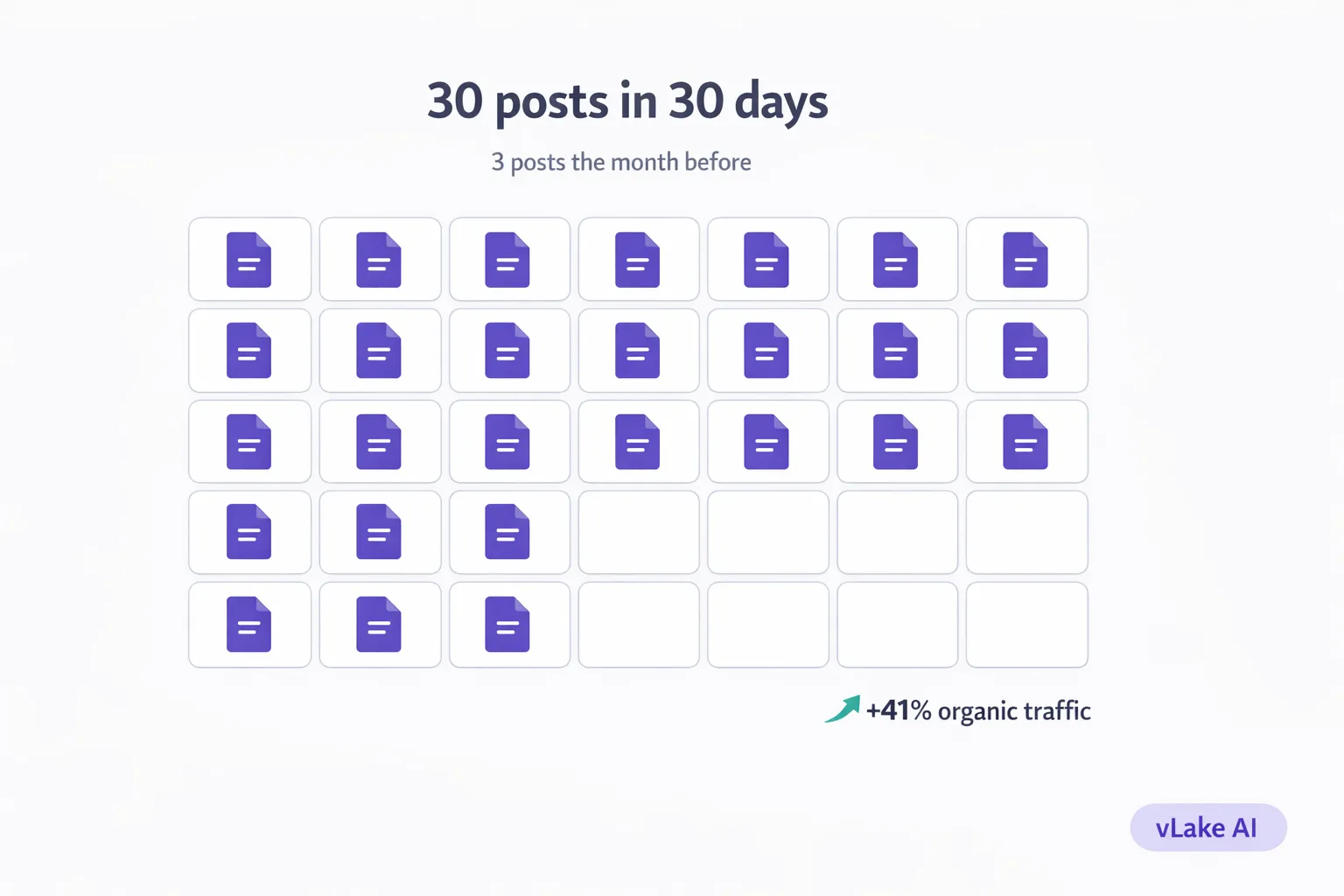
Last month we published 30 blog posts across our WordPress site. Not repurposed content. Not filler. Thirty original posts, each one targeting a specific keyword, written for a specific audience, with a featured image and complete SEO metadata.
We didn’t hire a content team. We didn’t outsource to an agency. We used our own tool.
This isn’t a success story about AI being perfect. Some of those posts needed editing. A few missed the mark entirely. But what I learned about running content at volume changed how I think about blogging for our business, and I don’t think we’re going back.
Why We Decided to Go All-In on Volume
For most of the past year, we published two or three blog posts a month. They were good. Well-written, well-researched, properly formatted. And almost nobody read them.
Here’s the thing about SEO content: quality matters, but coverage matters more than most people admit. Three perfect posts a month means three chances to rank. Three keywords. Three entry points into your site from Google. That’s not enough surface area to compete with anyone publishing weekly, let alone daily.
We knew this. We’d tell our own users to publish more consistently. But we weren’t doing it ourselves because the cost of producing each post was too high. Every blog took someone three to four hours from outline to publish. At that rate, even doubling output meant stealing a full workday every week.
So we ran an experiment. One month. Thirty posts. All generated through vLake’s pipeline with real editorial oversight. The goal wasn’t to see if AI could write. We already knew it could. The goal was to see what happens to a site when you suddenly go from three posts a month to thirty.
How We Set It Up
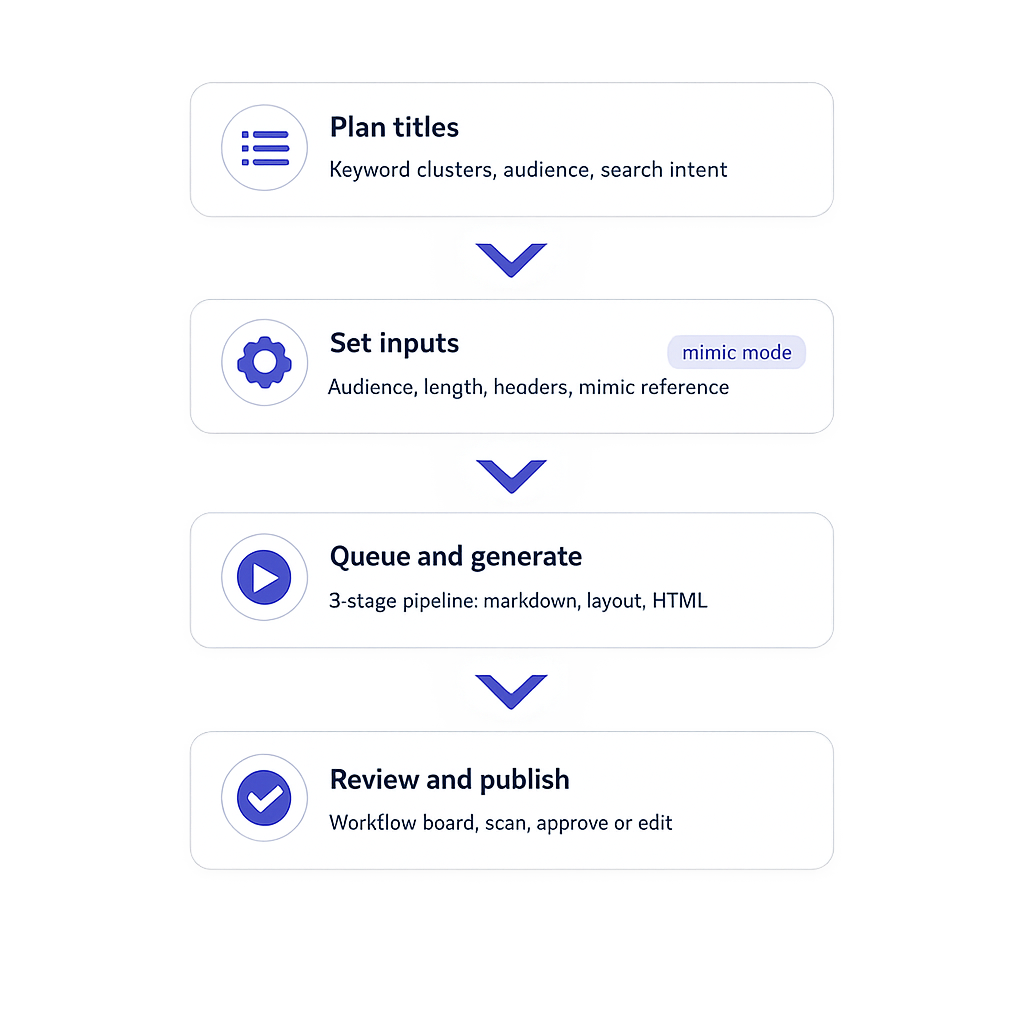
The first thing I did was spend half a day on titles. Not writing them randomly. Mapping out keyword clusters. We had a spreadsheet of about fifty topic ideas and I narrowed it down to thirty that covered different angles of our core categories. Each title targeted a specific search intent.
That planning step turned out to be the most important thing I did all month. vLake can write a post about anything, but the quality jumps noticeably when you give it a focused title with a clear audience in mind. A vague title like “WordPress Tips” produces generic content. A specific title like “How I Fixed My WordPress Page Speed Without Touching a Single Plugin” produces something with an actual point of view.
For each post, I set the audience (WordPress site owners, small business, or agencies depending on the topic), picked a length (mostly medium, a few long-form for competitive keywords), and added two or three header suggestions to steer the structure. Then I queued them.
The pipeline ran through three stages for each post. First it wrote the raw content in markdown. Then it arranged the layout and placed media slots. Then it converted everything to WordPress block HTML. I didn’t touch any of that. The posts showed up in my review queue on the workflow board, ready to scan.
I also set up mimic mode early on. We had one post from last year that perfectly captured how we want to sound. Conversational, specific, opinionated. I pointed vLake at it and used it as the reference for every post. That one decision saved me hours of tone editing later. Without it, the posts were fine but inconsistent. With it, they read like the same person wrote all of them.
What Actually Happened Week by Week
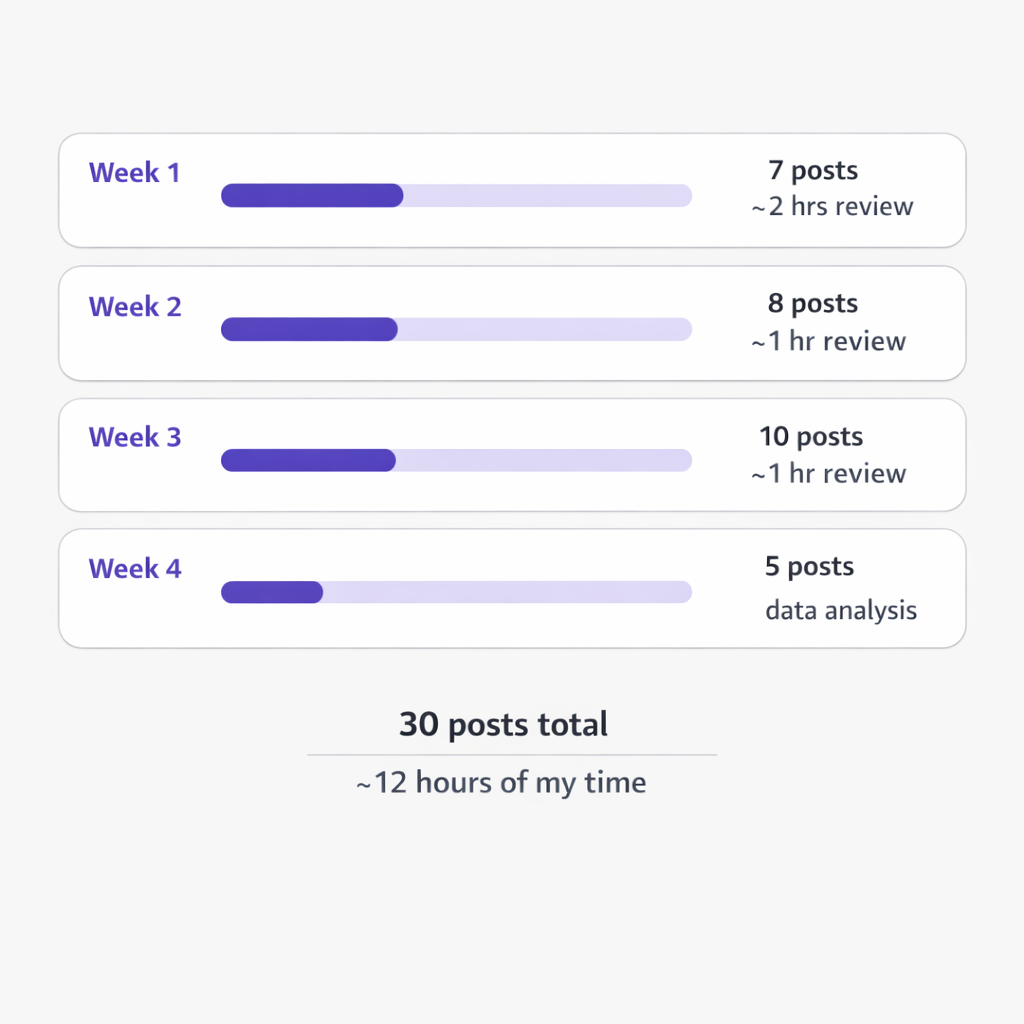
**Week one** was mostly setup and calibration. I published the first seven posts and spent about two hours reviewing them. Two needed real edits, mostly because my title was too broad and the content reflected that. The other five I approved with minor tweaks. I also generated featured images for all of them using vLake’s flat design preset. That alone would have taken me a full day if I’d been sourcing or designing images manually.
**Week two** I got faster. Published eight posts. Review time dropped to about an hour because I’d gotten better at writing titles that produce focused content. I started noticing something in our analytics. Pages were getting indexed faster than I expected. Google was crawling more frequently. I assume because the site was suddenly producing fresh content consistently.
**Week three** I pushed ten posts. This was the week I stopped thinking about individual posts and started thinking about coverage. I wasn’t asking “is this post good enough?” I was asking “does this post cover a search query that nothing else on our site covers?” That shift in thinking was the real lesson. When you can produce content at volume, your strategy changes from “make each post count” to “cover the territory.”
**Week four** I published the remaining five posts and spent most of my time looking at the data from the first three weeks.
The Numbers After 30 Days
Here’s what the dashboard showed after one month.
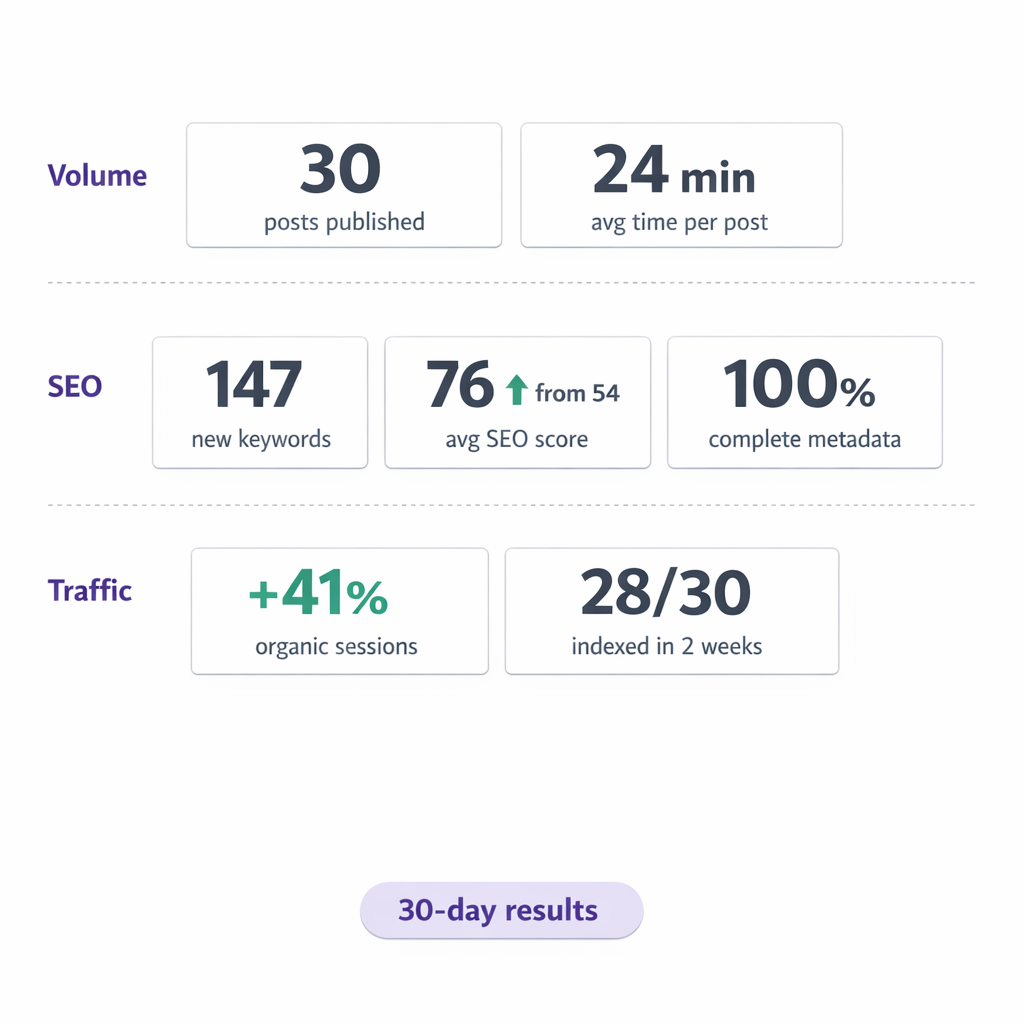
**Content volume:**
- Posts published: 30 (up from 3 the previous month)
- Total time I spent: roughly 12 hours across the month (planning, reviewing, editing)
- Average time per post: about 24 minutes of my time
**SEO impact:**
- New keywords ranking (positions 1-50): 147
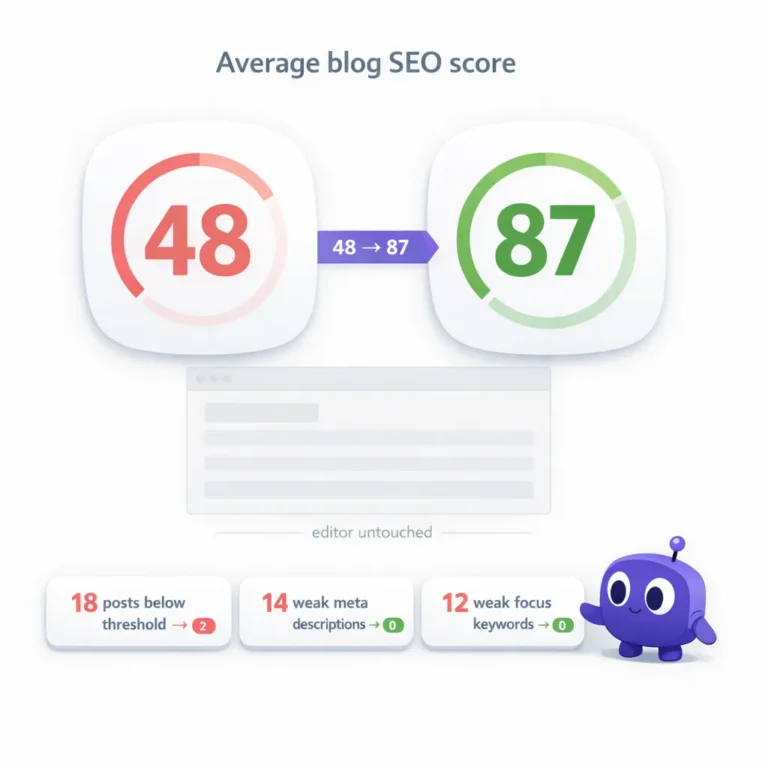
- Average blog SEO score: 76 (up from 54 on our old posts)
- Posts with complete meta descriptions: 100%
- Posts with featured images: 100%
**Traffic:**
- Organic sessions: +41% month over month
- New pages indexed: 28 out of 30 within two weeks
- Top performing new post: ranked position 8 for its target keyword within 19 days
The keyword number is the one that mattered most to me. We went from ranking for maybe 40 keywords total to 187. That’s not because any individual post was exceptional. It’s because we had thirty posts covering thirty different queries that we simply weren’t present for before.
Five Things I Actually Learned
**1. Titles are the real input.** The AI is only as good as what you ask it to write. A lazy title produces lazy content. A specific, opinionated title with a clear audience produces something worth publishing. I spent more time on titles than on reviewing finished posts.
**2. Volume changes your strategy.** When you can only publish three posts a month, you agonize over each one. When you can publish thirty, you start thinking about keyword coverage, topic clusters, and search territory. It’s a different game entirely.
**3. Consistency beats perfection.** Five of the thirty posts were noticeably weaker than the rest. I published them anyway. Two of those five ended up ranking because they targeted low-competition queries that nobody else was writing about. If I’d held them to my old standard, I would have killed them in editing.
**4. Mimic mode is not optional.** The first few posts I generated without mimic mode were fine but felt disconnected from each other. Once I set the reference post, everything clicked. Brand voice at scale requires a reference point, not a style guide.
**5. The review step matters more than the writing step.** My job shifted from writer to editor. I wasn’t creating content anymore. I was curating it. Scanning for accuracy, checking that the tone felt right, making sure the SEO metadata made sense. That’s a fundamentally different (and faster) skill than writing from scratch.
What I’d Do Differently Next Time
I’d spend a full day on title planning before generating a single post. My first week’s posts were the weakest because I rushed the titles. I’d also batch by topic cluster instead of publishing randomly. Grouping related posts together and interlinking them would have boosted the SEO impact faster.
And I’d start with mimic mode from day one. The three posts I generated before setting up a reference post still don’t quite match the rest. They’re fine, but they feel like they were written by a different person.
What This Means If You’re Thinking About Scaling Content
You don’t need to publish thirty posts in a month. That was an experiment. But the lesson scales down. Even going from two posts a month to eight changes your SEO surface area dramatically. The bottleneck was never ideas. It was production.
If you’re sitting on a list of blog topics you’ve never had time to write, that list is your starting point. The titles are the hard part. Everything else is pipeline.
I still edit every post before it goes live. I probably always will. But I’m editing, not writing. And that’s the difference between three posts a month and thirty.