


The Case for Letting an AI Agent Manage Your WordPress Site Instead of Doing It Yourself
The best argument for AI site management isn’t what it does. It’s what you’ll never get around to doing yourself.
Not because you’re lazy. Because the list of things a WordPress site needs is longer than the time you have available to do them. And it gets longer every month.
This isn’t a feature tour. It’s a straightforward argument for why the manual approach to WordPress management doesn’t hold up past a certain point, and why handing the recurring work to an autonomous agent produces better outcomes than doing it yourself.
The Maintenance Math Doesn’t Work
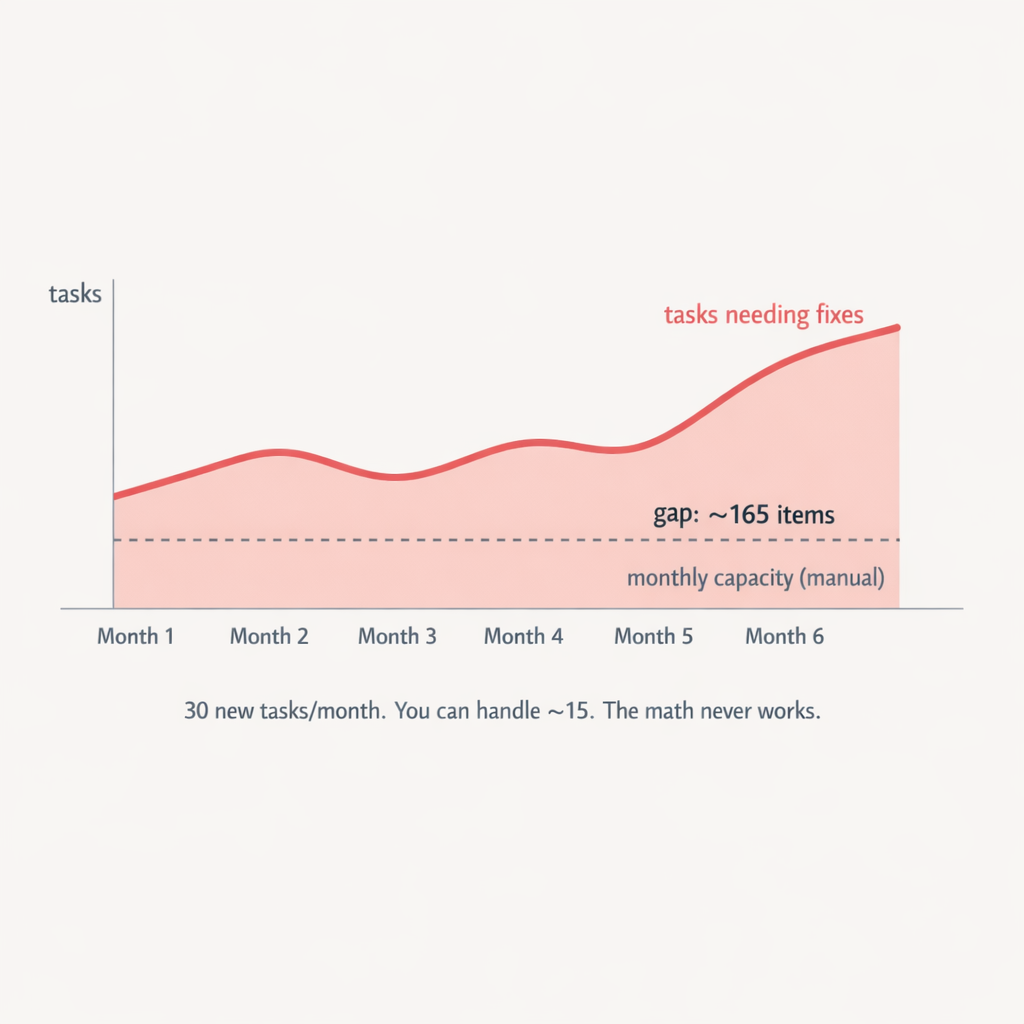
A WordPress site with 50 blog posts, 200 images, a dozen plugins, and an active publishing schedule generates roughly 30 new maintenance tasks per month. That number comes from what we see across the sites connected to vLake. It’s consistent.
Those 30 tasks break down into: SEO metadata that needs writing or updating for new and edited posts, images that need compression and alt text, plugin versions that need reviewing and updating, taxonomy assignments that need cleaning, and content formatting that needs checking after theme or plugin changes.
At five minutes per task, that’s 2.5 hours per month just to stay current. Not to clear any backlog. Just to keep up with what’s new.
If you’re already behind (and most sites are), add the existing backlog. The average site we connect has about 80 outstanding items on first scan. At five minutes each, that’s another 6.5 hours to clear.
So month one costs you roughly 9 hours to get current and stay current. Month two, if you keep up perfectly, costs 2.5 hours. Month three, same. But “keep up perfectly” is the part that fails. One busy week where you skip maintenance, and you’re behind by 7-8 items. Two busy weeks and you’re behind by 15. The gap reopens. The math goes back to working against you.
Manual maintenance only works if you never miss a week. In practice, everyone misses weeks.
The Discovery Problem
You can only fix what you know about. That sounds obvious, but it’s the core failure of manual WordPress management.
When you manage a site manually, you discover problems when you happen to look. You log in, open a post, notice the meta description is missing. But you only noticed because you opened that specific post. The other 23 posts with the same problem? You didn’t open those today. You might not open them this month.
Manual discovery is periodic and random. You find issues based on what you happen to look at, not based on what’s actually wrong. A post published six months ago with no focus keyword might sit that way for another six months because you have no reason to revisit it.
Automated scanning inverts this. The scanner checks every post, every image, every plugin, every taxonomy structure on a regular cycle. It doesn’t get distracted. It doesn’t skip posts because it’s running low on time. It doesn’t miss the image uploaded three months ago that still has “IMG_4392.jpg” as its alt text.
The difference isn’t intelligence. It’s coverage. A human managing a site sees a fraction of the problems that exist. A scanner sees all of them.
The Execution Problem
Knowing what’s wrong and fixing it are two different jobs that require two different time commitments.
I’ve watched site owners run SEO audits, get a list of fifty items that need fixing, and then close the report because they don’t have time to work through it. The audit was useful. The execution never happened.
This is common with external tools too. You run a PageSpeed test, see that seven images need compression, and add it to your to-do list. The to-do list grows. The images stay uncompressed.
The gap between knowing and doing is where most maintenance dies. People don’t fail at awareness. They fail at follow-through. Not because they don’t care, but because follow-through takes time they’ve already allocated to something else.
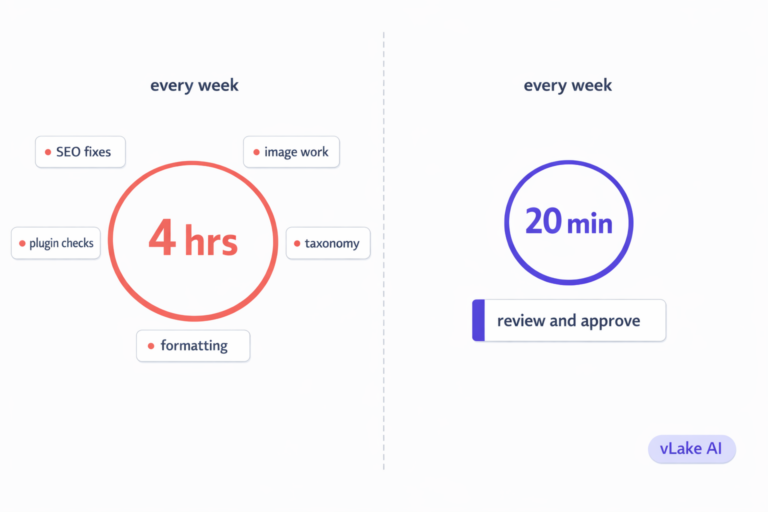
An autonomous agent closes this gap by handling both sides. The scanner identifies the issue. The execution layer fixes it. The result lands in a review queue for you to approve. You’re not doing the work. You’re approving the work. That takes a fraction of the time and none of the context-switching.
What Autonomous Actually Means
I want to be clear about what autonomous management is and isn’t, because the word carries more weight than it should.
It doesn’t mean the AI runs your site without your input. Nothing gets pushed to your live WordPress site without going through a review step. Generated content, rewritten metadata, optimized images, plugin changes. Everything lands in a review queue. You approve, edit, or dismiss each item.
The actual loop looks like this. The scanner runs continuously and creates recommendations when it finds something below threshold. SEO score too low, image too large, alt text missing, plugin outdated. Each recommendation has a type and a target resource.
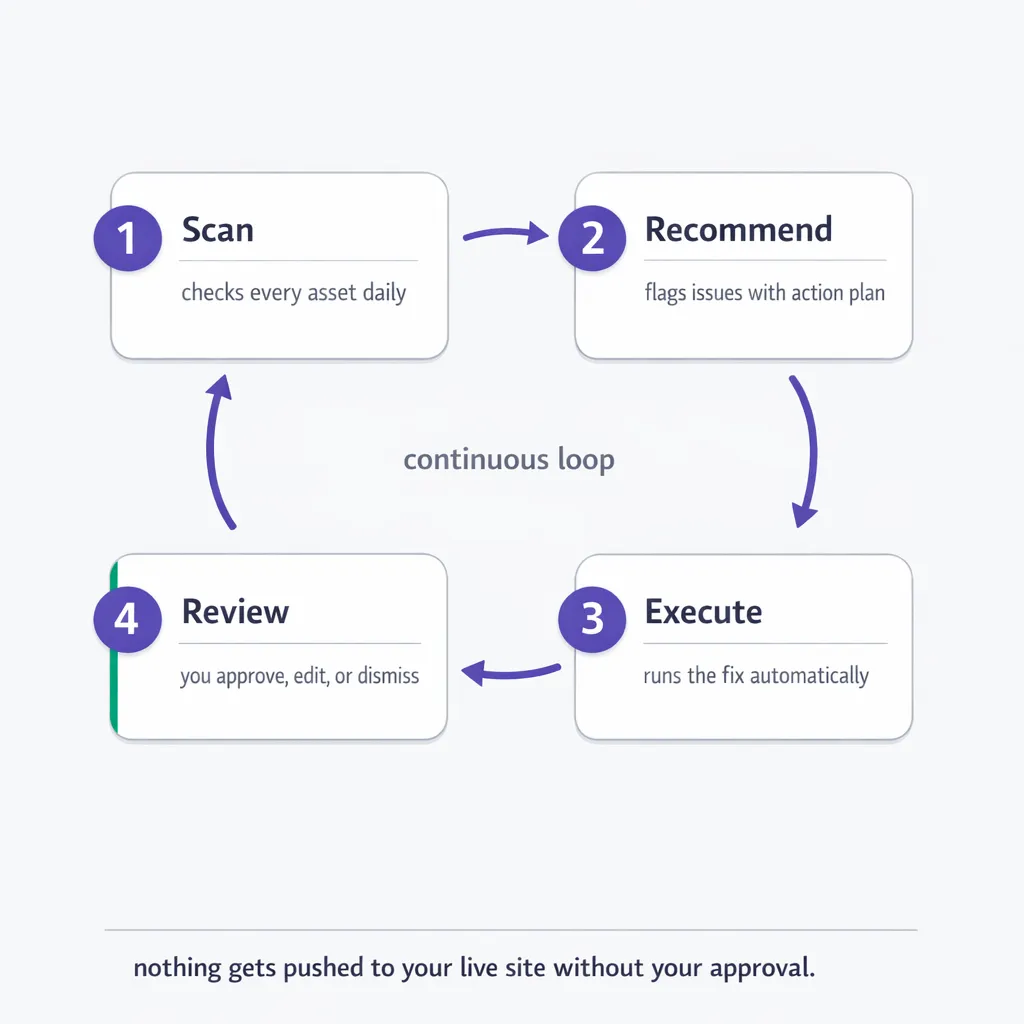
The execution layer picks up those recommendations and runs the appropriate fix. SEO metadata gets rewritten. Images get converted to WebP. Alt text gets generated. Plugin statuses get flagged.
The fixed items land in your review queue. You scan them. Approve the good ones. Edit the ones that need adjustment. Dismiss anything irrelevant.
Your role shifts from “find and fix” to “review and approve.” That’s a fundamentally different level of effort. Finding a problem takes time. Reviewing a proposed fix takes seconds.
The system also deduplicates automatically. Every recommendation has a unique key. If a post was already flagged for missing SEO metadata and the fix is pending, it won’t be flagged again. Your queue stays clean. No duplicates, no noise.
The Real Comparison: 6 Months Side by Side
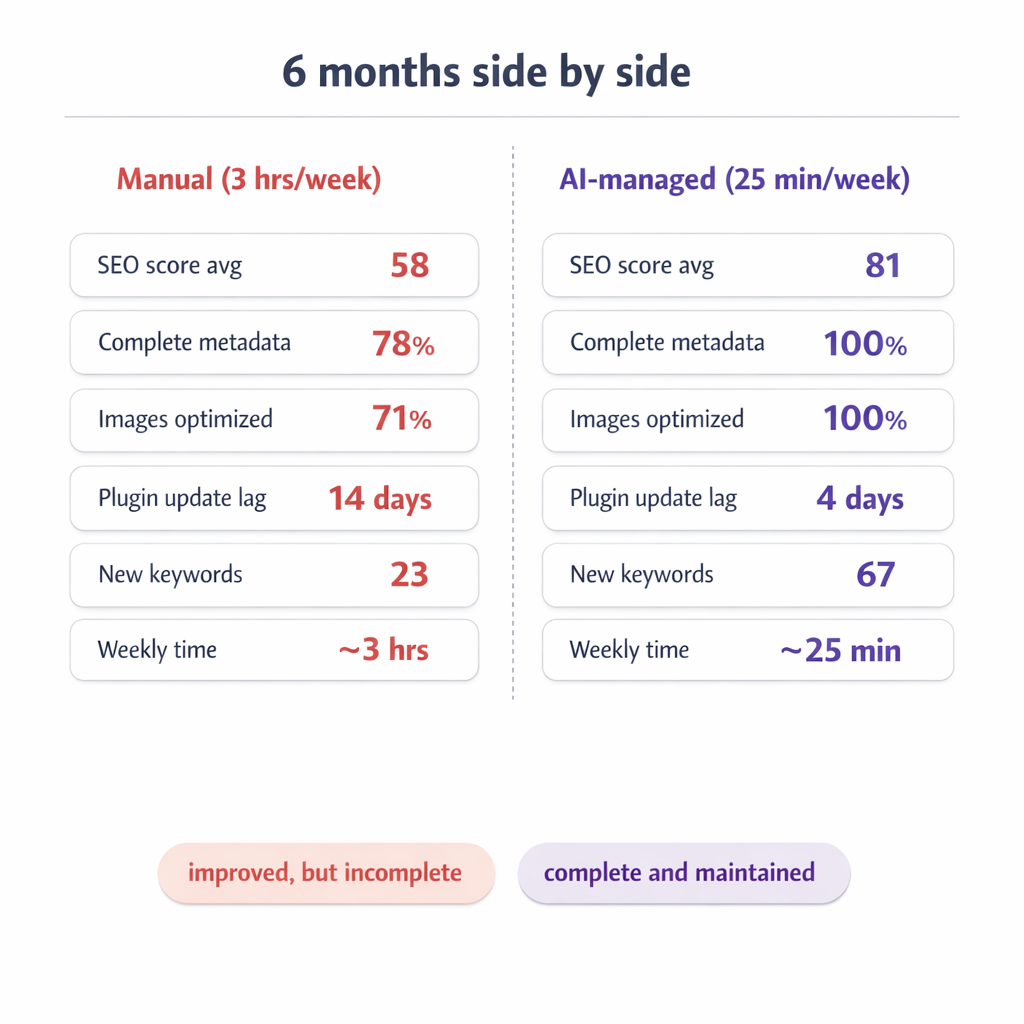
We tracked two sites with similar starting conditions over six months. One managed manually by the owner (dedicated, not negligent, spending about 3 hours per week on maintenance). The other managed through vLake with about 25 minutes of review time per week.
**Manually managed site after 6 months:**
- Blog SEO score average: 58 (started at 52, improved slowly)
- Posts with complete metadata: 78% (backlog partially cleared, new posts mostly complete)
- Images optimized: 71% (cleared most of the backlog, missed some new uploads)
- Plugin update lag: 14 days average
- New keyword rankings gained: 23
- Weekly time spent: ~3 hours
**AI-managed site after 6 months:**
- Blog SEO score average: 81 (started at 51, cleared backlog in 2 weeks)
- Posts with complete metadata: 100% (maintained continuously)
- Images optimized: 100% (new uploads caught within 24 hours)
- Plugin update lag: 4 days average
- New keyword rankings gained: 67
- Weekly time spent: ~25 minutes
The manually managed site improved. The owner worked hard and made real progress. But the gap between working hard and working systematically shows up in the numbers. 78% complete metadata vs 100%. 71% optimized images vs 100%. 23 new keywords vs 67. Three hours a week vs 25 minutes.
The manual approach isn’t bad. It’s incomplete. And it’s incomplete not because of effort, but because of capacity.
When Manual Still Makes Sense
Content strategy is manual. Deciding what topics to write about, which keywords to target, how to position your brand. That requires understanding your business, your audience, and your competition in ways that AI doesn’t.
Brand voice is manual. Setting up mimic mode, choosing a reference post, deciding whether a generated post captures the right tone. The system can match a voice. It can’t choose one.
Client relationships are manual. Understanding what a client wants, translating vague feedback into actionable changes, knowing when to push back on a bad idea. That’s human work.
The creative and relational work stays with you. The recurring production and maintenance work goes to the agent. That split is the actual case being made here. Not “AI replaces you.” AI takes the work that was burying you so you can focus on the work that only you can do.
The honest version of the argument is simple. You’ll never maintain your WordPress site as consistently as an automated system will. Not because you’re not good enough. Because you have other things to do.