

Why Meta Descriptions Were Always My Last Priority
I have never met a WordPress site owner who loves writing meta descriptions.
People like publishing. They like tweaking headlines. They like redesigning pages they probably should have left alone. But writing thirty or forty clean, specific meta descriptions for old posts? That is where motivation goes to die.
That was definitely true for me.
When I published a new post, I usually told myself I would write the meta description right before hitting publish. Sometimes I did. A lot of the time I wrote something rushed, overly generic, or clearly copied from the first paragraph because I just wanted to move on.
Older posts were worse.
Those either had thin descriptions I wrote too fast, or nothing useful at all. And because meta descriptions sit outside the main body content, they are easy to forget about. The post looks finished in WordPress, so your brain files it under done even when the SEO layer around it is sloppy.
I think that is the real reason this problem lingers. Most WordPress meta descriptions are not bad because site owners do not care. They are bad because nobody wants to do them at scale, especially not for content that is already live.
Why I Let AI Handle It
The thing that pushed me over the edge was realizing I had started avoiding the cleanup entirely.
I would open Rank Math, see a list of posts with weak or missing SEO fields, fix one or two, then close the tab because the work felt repetitive almost immediately. The problem was not that I did not know what to do. The problem was that I did not want to spend another afternoon writing tiny summary lines for articles I had already spent hours writing in the first place.
So I let vLake take over that part.
What made it feel worth trying was that it was not just “generate some text and good luck.” vLake scanned the blog library, surfaced low-scoring items through the recommendation engine, and generated Rank Math-compatible metadata for the posts that needed it. That gave the process structure.
I set the SEO threshold, let it run the first pass, and decided I would review the early batch before trusting it fully. That was important. AI-written meta descriptions can go bland fast if you never check them.
What vLake Actually Wrote
The first pass surfaced `24` blog posts with weak or missing meta descriptions.
That was not shocking.
What did surprise me was how many of those posts were ones I still considered “done.” The articles themselves were fine. Good, even. The weak spot was the packaging around them. A strong post with a lazy meta description still looks unfinished once you see it next to cleaner metadata.
vLake generated new descriptions based on the actual content of each post and packaged them into the same workflow as the other SEO cleanup. That mattered because it turned a vague problem into a list I could review.
Some of the outputs were instantly better than what I had written in a rush.
Some were too safe.
That was the one thing that did not work perfectly on the first batch. A few descriptions sounded technically fine but a little samey, like they had the right information without enough personality. So I reviewed those early ones closely, approved the good ones, rejected the bland ones, and let that shape what I trusted going forward.
After that, it got easier. Much easier.
The descriptions stopped feeling like a writing chore and started feeling like maintenance finally getting handled.
What Changed When the Meta Descriptions Got Cleaned Up
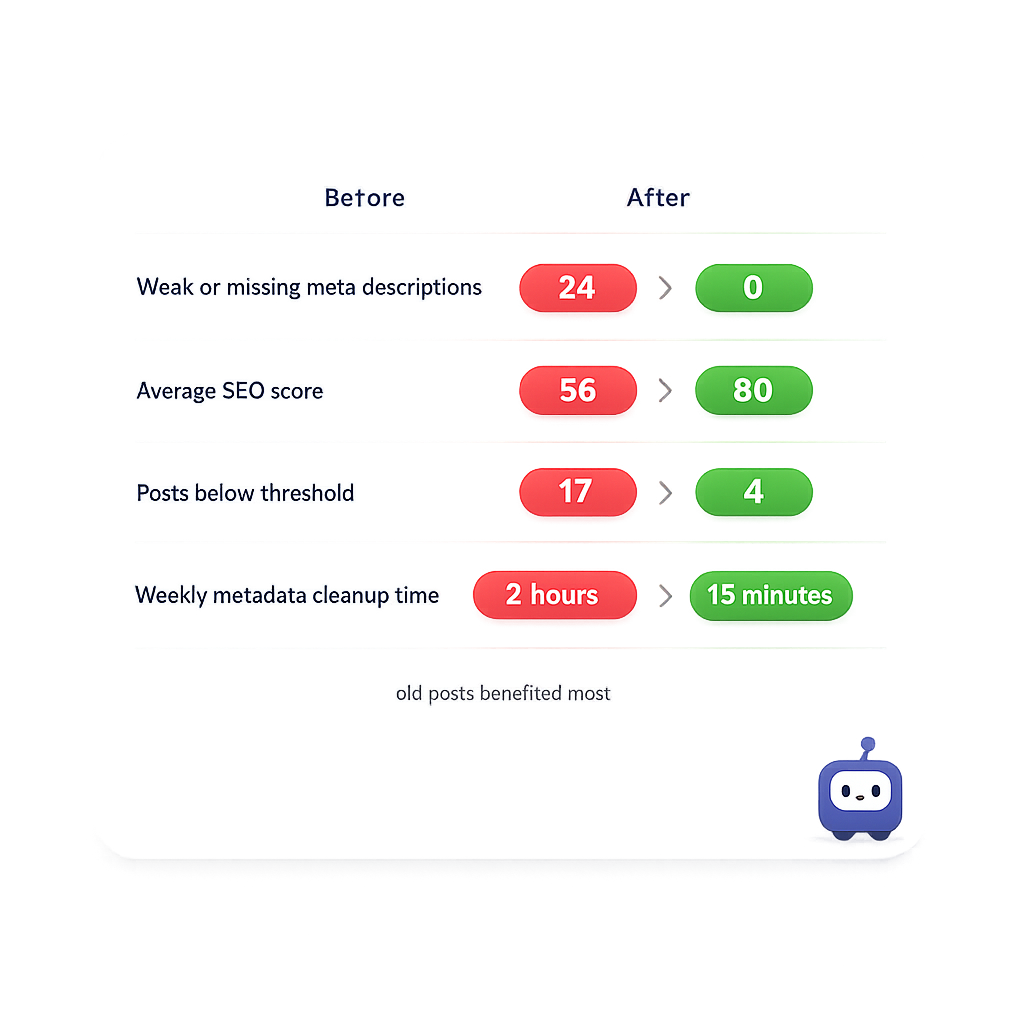
The obvious change was completeness.
`24` weak or missing meta descriptions went to `0` across the posts I prioritized. That alone made the blog feel more consistent, because now the archive was not a mix of careful SEO on new posts and abandoned metadata on older ones.
But the more useful change was what happened around the scores.
Once the descriptions were updated, the affected posts moved through the rerank flow properly. That mattered because I was no longer guessing whether the cleanup helped. Posts marked with `needsRerank` got rescored after the metadata updates, so I could see whether the improvements were real instead of just feeling productive.
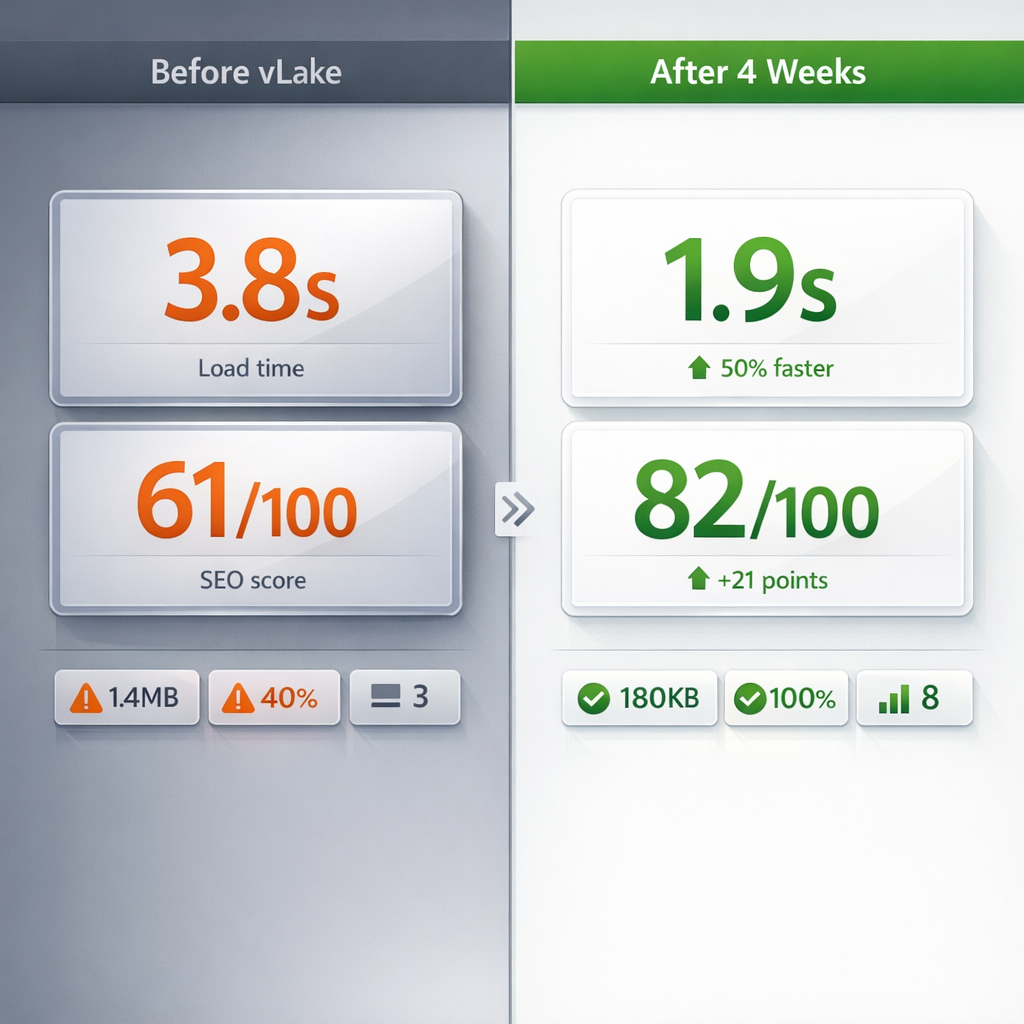
After about three weeks, this is where things landed:
Before
- Posts with weak or missing meta descriptions: `24`
- Average SEO score across the priority posts: `56`
- Posts below SEO threshold: `17`
- Weekly time spent doing manual metadata cleanup: about `2 hours`
After
- Posts with weak or missing meta descriptions: `0`
- Average SEO score across the priority posts: `80`
- Posts below SEO threshold: `4`
- Weekly time spent doing manual metadata cleanup: about `15 minutes`
The surprise for me was not that the scores moved. It was which posts improved the most.
It was the older posts.
The recent content I had published in the last month or two was messy, but not disastrous. The archive was where the real lift came from. Posts I had not touched in ages suddenly looked cleaner, more deliberate, and less neglected once the descriptions were rewritten properly.
What I Learned From Letting AI Do the Most Repetitive Part
I learned that meta descriptions are exactly the kind of SEO work AI is good at, as long as you treat it like assisted cleanup instead of magic.
If the underlying post is weak, an AI-written meta description is not going to save it. And if you never review the output at all, some descriptions will drift toward generic phrasing. That is just true. You still need a human standard.
But if the article is already solid and the problem is that the SEO wrapper around it is rushed, inconsistent, or missing, this is where AI earns its keep. The best descriptions vLake wrote were not flashy. They were clear. Specific. Better aligned with the actual content than the lazy versions I had written when I was trying to publish fast.
I also think this is one of the easiest places to overestimate the value of manual effort. I used to assume I should write every meta description myself because it was “important SEO copy.” In practice, rushed human-written metadata was not beating careful AI-assisted cleanup.
That was a slightly annoying thing to admit.
It was also useful.
What This Means for You
If your WordPress site has a lot of older posts, there is a good chance your meta descriptions are much worse than your actual content.
If you are publishing regularly, that gap gets bigger over time because the content archive grows faster than anyone’s willingness to maintain the tiny SEO fields around it. And if you manage multiple sites, it gets out of hand even faster.
So if you are wondering what happens when you let AI write all your WordPress meta descriptions, my answer is pretty simple: the archive gets cleaner, the SEO layer gets more consistent, and you stop burning hours on the most repetitive part of the job.
What Changed Most
I did not get better at writing meta descriptions. I just stopped making myself do the part I was always going to avoid.