

The SEO Work I Kept Postponing
I didn’t ignore WordPress SEO because I thought it was unimportant. I ignored it because it was annoyingly repetitive, weirdly manual, and never fully done.
Every week I had the same little pile of tasks waiting for me. Open Rank Math. Check which posts had weak scores. Rewrite a few meta descriptions. Add a focus keyword I meant to add when I published. Notice an older post still had no proper SEO title. Promise myself I’d clean up the archive on Friday. Then not do it.
That was the pattern for months.
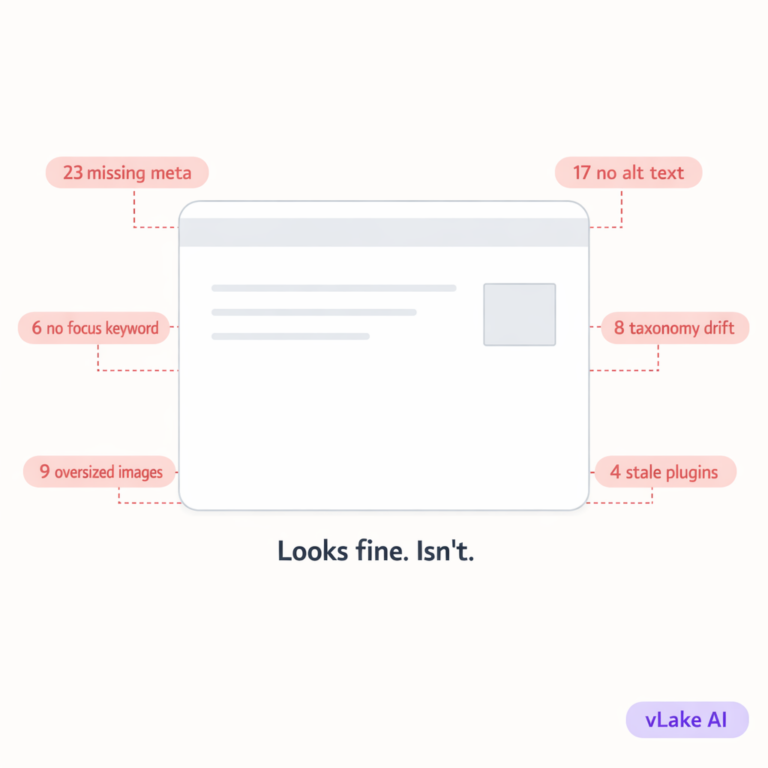
New posts got most of my attention because they felt urgent. Old posts just sat there collecting tiny SEO problems. Nothing catastrophic. Just enough mess to drag the whole site down. A blog post with a decent body and no clear seo_desc. A page that had drifted below the threshold because I’d edited the copy and never reranked it. Images with missing alt text. Metadata that technically existed, but felt like I wrote it in a rush because, honestly, I did.
I tried fixing it the normal way. I blocked off Monday mornings for SEO cleanup. That lasted maybe two weeks. I tried doing five posts at a time so it felt manageable. It still felt like bookkeeping. I even thought about hiring someone to do the cleanup, but paying a person to spend hours rewriting metadata inside the editor felt like a terrible use of time.
Here’s the thing: I don’t think most WordPress SEO problems come from bad strategy. I think they come from backlog. The site grows faster than the maintenance habit around it.
Why I Let the Agent Take Over
What made me try vLake wasn’t some grand belief that AI should run everything. It was the opposite. I was tired of pretending I was definitely going to keep up with the boring parts myself.
vLake’s pitch made sense to me because it wasn’t just “here are your SEO issues.” I’ve used enough tools that can point at a problem and then quietly leave me to deal with it. vLake scans the site, creates recommendations, and actually executes the cleanup work when I let it. That’s a very different promise.
So I let it do one thing first: scan the whole site and show me what it thought needed attention.
That first pass was exactly the kind of wake-up call I needed. It surfaced low-scoring blog posts, missing meta descriptions, posts without a clear focus_keyword, and a handful of images that were dragging along without alt text. It also made the work feel finite for the first time. Instead of a vague sense that “my SEO probably needs work,” I had an actual queue.
I set the SEO threshold, let the recommendation engine do its thing, and decided I’d review the first batch before trusting it fully. I’m glad I did. AI-written SEO can get repetitive if you never sanity-check the early outputs. The first few rewrites were solid, but reviewing them helped me calibrate what I liked and what felt too generic.
After that, I stopped trying to micromanage it.
What the Agent Actually Changed
The most useful part wasn’t some flashy dashboard moment. It was the boring consistency.
vLake went through the posts that were sitting below my SEO threshold and generated Rank Math-compatible metadata for them: focus_keyword, seo_title, and seo_desc. That matters more than people admit. When you’ve got dozens of posts, even a site with good content starts feeling uneven if the metadata was written at three different quality levels over two different years.
It also worked the way I wanted operationally. A post would get flagged, metadata would be generated, and the content would be marked for reranking with the needsRerank flow so the score could be recalculated after the update. I didn’t have to jump in and manually babysit every little change just to see whether the cleanup moved the needle.
The archive cleanup was where I really felt the difference. I had older posts I’d published fast, posts I’d updated without fixing their metadata, and a few pieces that clearly deserved better titles than the ones I gave them late at night. vLake handled those faster than I would have, and probably more consistently too.
It picked up supporting SEO work as well. A few images with missing alt text got cleaned up during the same stretch, which I liked because that’s exactly how SEO work happens in real life. It’s rarely one big dramatic fix. It’s a stack of small neglected things getting resolved in the right order.
What surprised me was how little time I spent in the editor once I trusted the workflow. I wasn’t opening post after post just to type what were basically the same four kinds of corrections. I was reviewing outcomes instead of doing mechanical rewriting.
What Changed After 30 Days
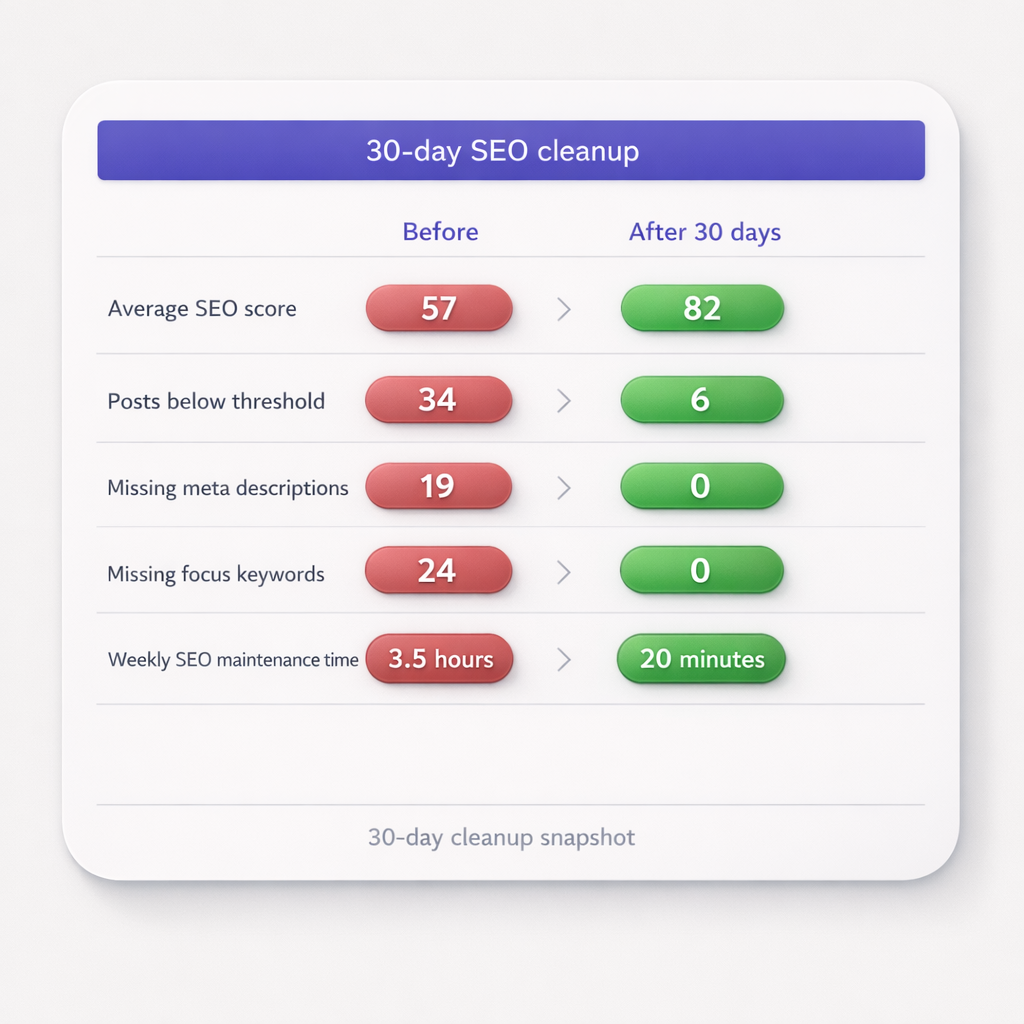
After 30 days, the site felt less chaotic. More importantly, the numbers backed that up.
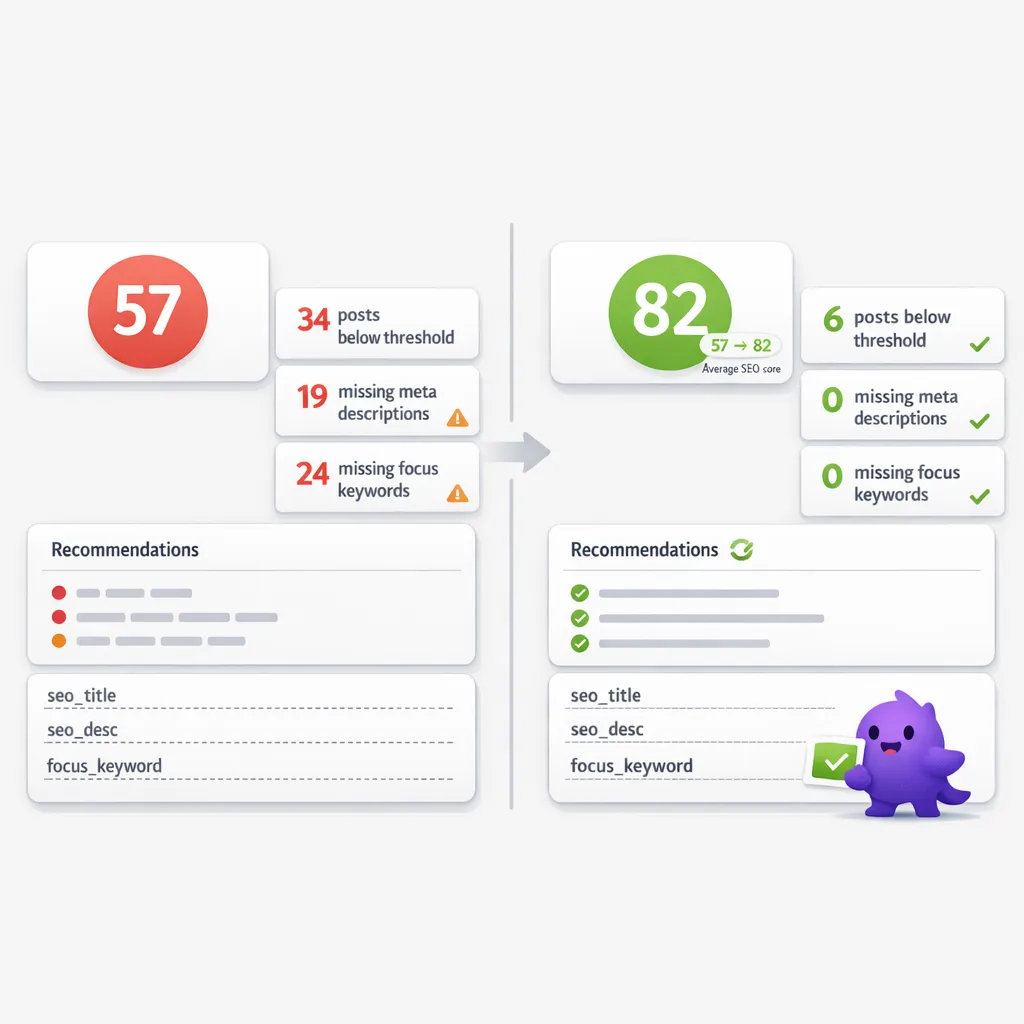
Before vLake
- Average SEO score: 57
- Posts below threshold: 34
- Posts missing meta descriptions: 19
- Posts missing focus keywords: 24
- Weekly SEO maintenance time: 3.5 hours
After 30 days
- Average SEO score: 82
- Posts below threshold: 6
- Posts missing meta descriptions: 0
- Posts missing focus keywords: 0
- Weekly SEO maintenance time: 20 minutes
Those numbers didn’t happen because the AI invented some secret ranking trick. It happened because the site finally got the consistency work it had been missing for a long time.
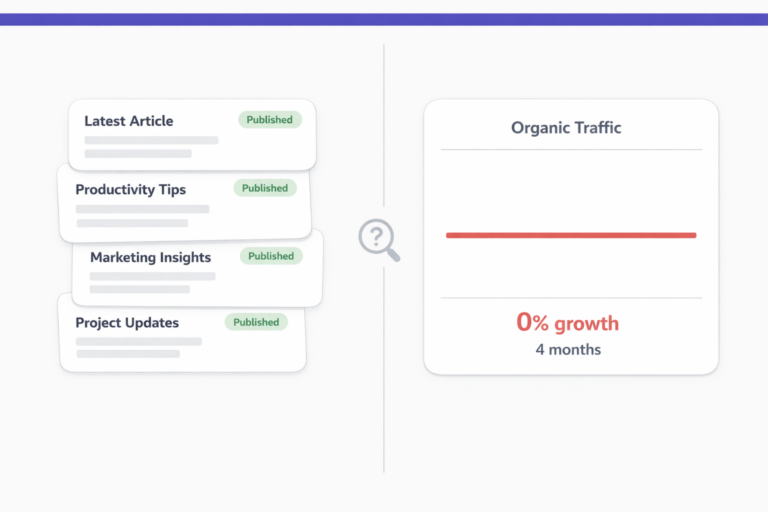
And no, rankings and traffic didn’t magically explode in a week. I want to be clear about that. The immediate win was cleaner metadata, stronger coverage across old content, and a site that looked maintained instead of half-maintained. That’s still a big win. I think people underestimate how much value there is in simply getting your archive under control.
The biggest surprise was this: the new posts were not the story.
The story was the backlog. The older posts I hadn’t touched in months. The half-finished SEO on pages that were already live. The long tail of small issues that never felt urgent enough to fix manually, but absolutely added up once the agent worked through them sitewide.
Who This Helps
If you’re running a business site and SEO keeps dropping to the bottom of your list, this kind of setup makes a lot of sense. You still care about search. You just don’t want to spend your evenings rewriting metadata for posts you published last quarter.
If you’re managing multiple WordPress sites, I think this gets even more compelling. The real pain isn’t writing one good meta description. It’s keeping fifty of them from slipping out of date across pages, blogs, and media while everything else on the site keeps moving.
And if you’ve been telling yourself you’ll “do a proper SEO cleanup soon,” I can say from experience that soon keeps moving. That’s why I let the agent take over. I wanted the work finished instead of endlessly rescheduled.
What Actually Changed
I didn’t suddenly become better at WordPress SEO. I just stopped making myself do the part a machine could do every day without getting tired of it.