

I Was Publishing. Nothing Was Happening.
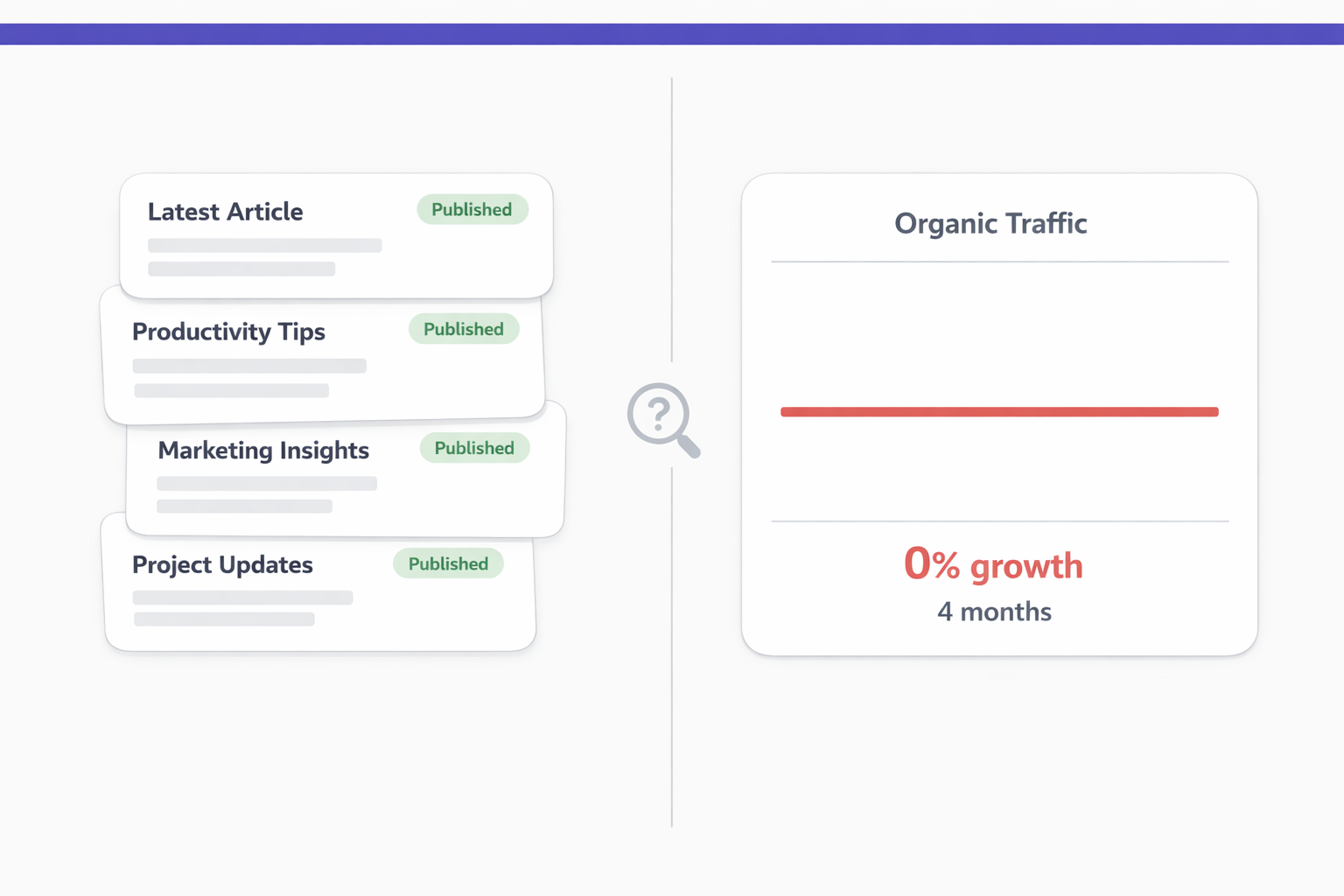
For about four months, I published two or three blog posts a week. Good posts. Relevant topics. Stuff my audience actually cared about.
Traffic didn’t move.
Not a dip. Not a spike. Just a flat line. The kind of flat line that makes you start questioning whether your site is broken, whether your hosting is throttling something, whether Google has some personal grudge against your domain.
I checked all the obvious things. The site loaded fine. Pages were indexed. Posts showed up in the CMS exactly the way they should. I was doing the work. The work just wasn’t working.
The Problem Wasn’t What I Was Writing
Here’s what my publishing workflow actually looked like.
I’d write the post. Pick a category. Hit publish. Move on to the next one. Sometimes I’d add a featured image. Sometimes I’d remember to write a meta description. Most of the time I told myself I’d go back and fill in the SEO details later.
I didn’t go back.
So what I actually had was a site full of content — 38 posts in six months — with almost no SEO infrastructure around it. The words were there. The metadata wasn’t. I was building a library that search engines couldn’t properly read.
I didn’t realise how bad it was until I looked at the numbers. Out of 38 posts, only 11 had complete SEO metadata. Twenty-two had no focus keyword at all. Nineteen had missing or weak meta descriptions. Forty-three images across the site had no alt text. Not poor alt text. None.
And the average SEO score across the whole site? 44.
I’d been publishing into a void. The content existed. The discoverability layer didn’t.
What Made Me Look Properly
I’d tried the usual approach. I opened Rank Math one Monday morning and started going through posts one at a time. Fill in the keyword. Write a meta description. Check the score. Move on.
After about 90 minutes, I’d fixed six posts. I had 27 more to go. And that didn’t include the pages, the media library, or any of the older posts that predated my “let me try to do this properly” phase.
That’s when I found vLake. Someone in a WordPress group mentioned it handled this exact kind of cleanup — not just flagging the issues, but actually generating the metadata and pushing it back to the site through Rank Math. I figured if it could save me from another three weekends of metadata entry, it was worth trying.
I connected the plugin, set my SEO threshold, and let the recommendation engine run.
What Was Actually Wrong
The scan confirmed what I already suspected but hadn’t wanted to count up.
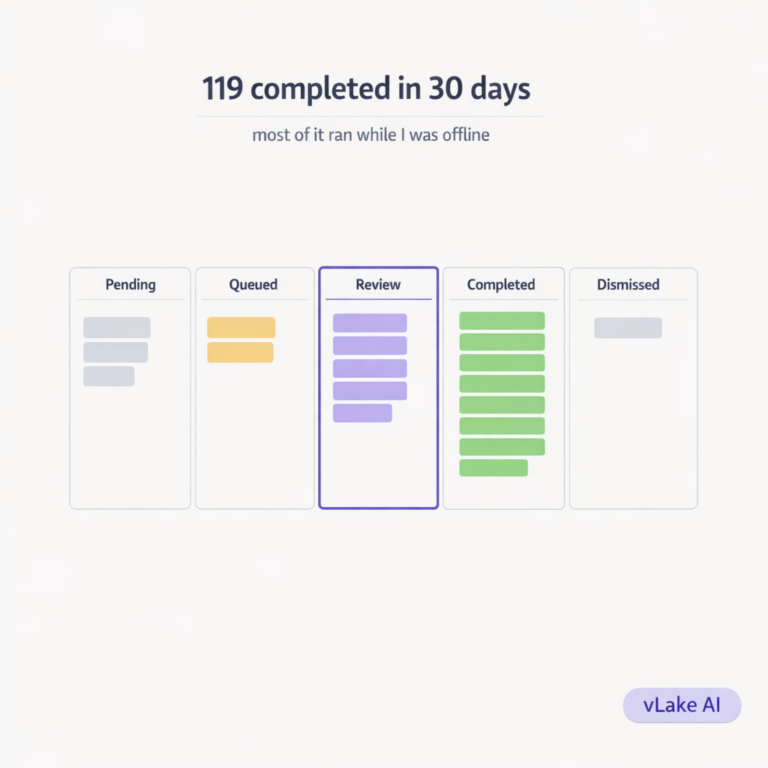
vLake surfaced every post, page, and media item with an SEO problem and ranked them in a recommendation queue. The queue was long. But for the first time, I could see the full picture instead of guessing.
The first thing that hit me: the focus keyword problem. Twenty-two posts with no focus keyword means twenty-two posts that Rank Math literally cannot score properly. I’d been publishing content without telling search engines what it was about. That’s not a strategy issue. That’s just skipping a step and not noticing.
The meta descriptions were the same story. Nineteen posts with nothing or a single weak sentence. Google was auto-generating snippets from whatever paragraph it pulled, which meant my search results looked random and unintentional — because they were.
The media library surprised me more than it should have. Forty-three images with no alt text. That’s 43 missed signals to search engines about what my pages contain. And 12 of those images were oversized — some over 2MB — which was quietly dragging my page speed down without me ever connecting those dots.
vLake worked through the queue over about three weeks. AI-generated focus keywords, meta titles, and descriptions pushed to Rank Math. Alt text written for every flagged image. Oversized images converted to WebP. The `needsRerank` flag made sure scores recalculated after each update, so I could actually see the cleanup moving the numbers.
I reviewed the first batch carefully. A few meta descriptions were a touch generic, so I adjusted those. The rest were better than what I’d have written at 11pm on a Tuesday, which is when I usually got around to SEO if I got around to it at all.
What Changed
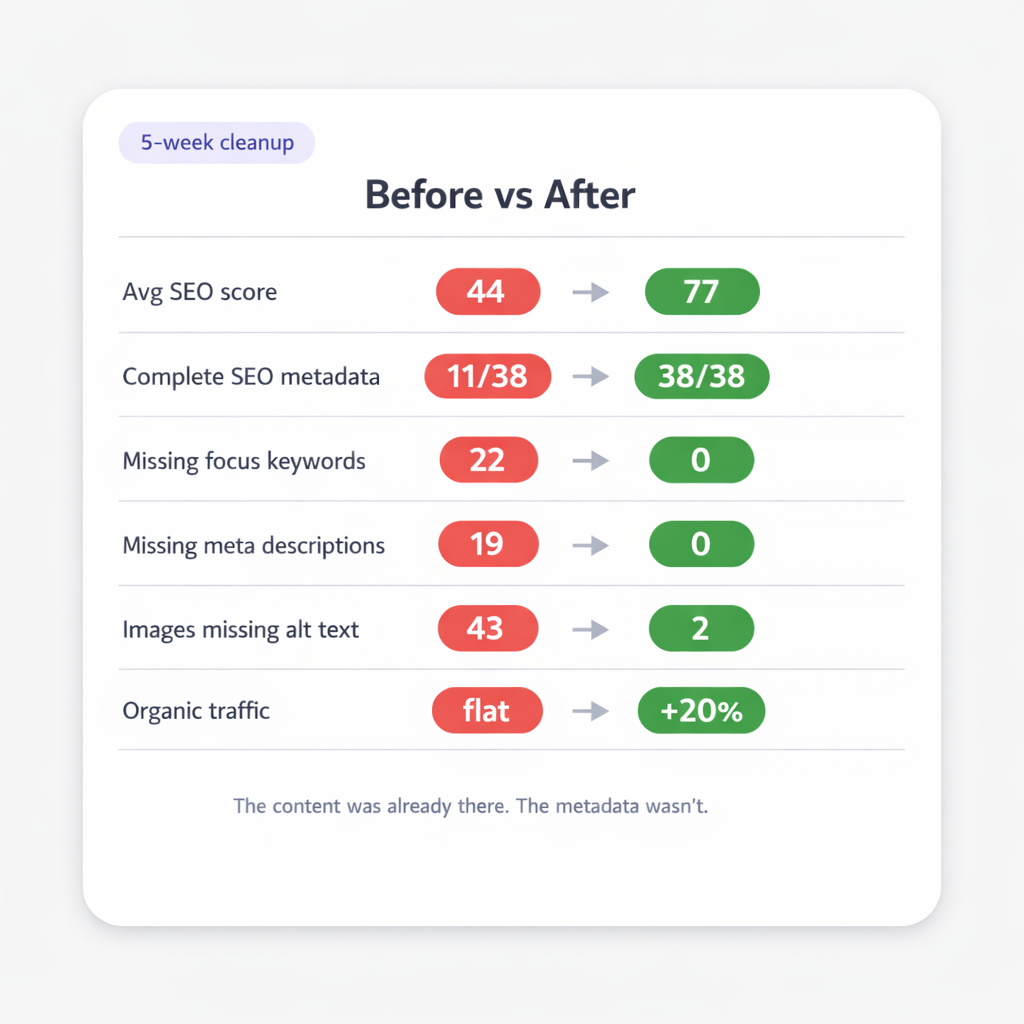
After five weeks, the site looked like a different property in Rank Math.
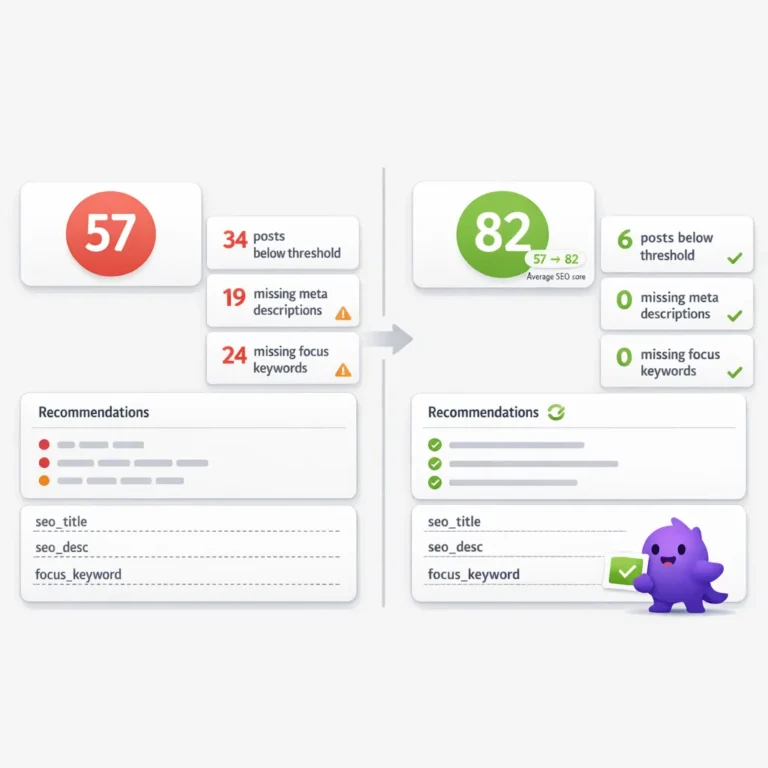
Before
- Average SEO score: 44
- Posts with complete SEO metadata: 11 of 38
- Missing focus keywords: 22
- Missing or weak meta descriptions: 19
- Images missing alt text: 43
- Organic traffic trend: flat for 4 months
After 5 weeks
- Average SEO score: 77
- Posts with complete SEO metadata: 38 of 38
- Missing focus keywords: 0
- Missing or weak meta descriptions: 0
- Images missing alt text: 2
- Organic traffic trend: up about 20% and climbing
The thing that surprised me: the traffic started moving within about two weeks of the metadata cleanup. Not dramatically. But visibly. After four months of nothing, visible movement felt like a lot.
It makes sense in hindsight. The content was already there. It was already indexed. It just didn’t have the right signals attached to it. Once the metadata was in place, search engines could actually understand what each post was about and rank it accordingly.
If Your Site Publishes But Nobody Finds It
If you’re publishing consistently and traffic isn’t responding, the problem probably isn’t your content. It’s everything around your content.
Check how many of your posts have a real focus keyword. Check how many have a proper meta description. Check your images for alt text. Check your page speed. These aren’t glamorous problems. But they’re the ones that sit between publishing a post and someone actually finding it through search.
I know because I spent four months blaming everything except the actual problem. The content was fine. The SEO wrapper was empty.
—
I didn’t need to write more. I needed to finish what I’d already published.